


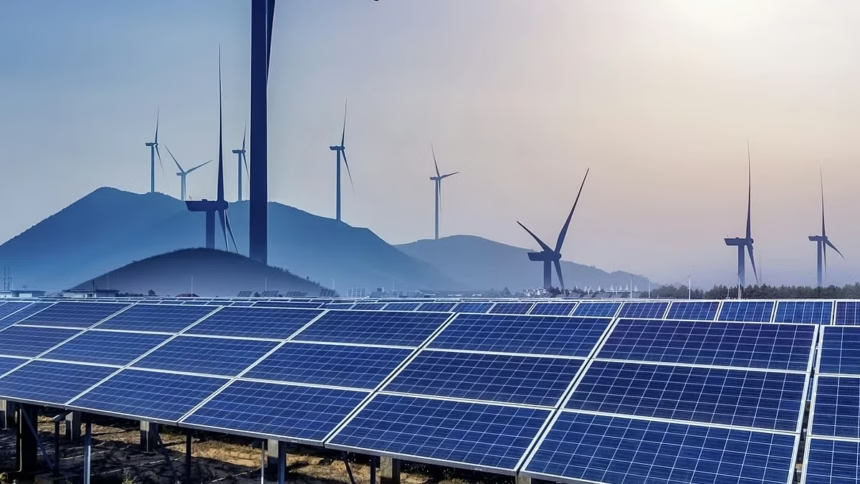
India renewable energy fuel import savings exceeded Rs 9.4 lakh crore between 2011 and 2025. The expansion helped reduce the country’s dependence on imported coal and natural gas, according to an International Energy Agency (IEA) report.
The report said India added 168 GW of solar capacity and 38 GW of wind capacity between March 2014 and September 2026. Meanwhile, bioenergy capacity reached nearly 12 GW by September 2026.
Furthermore, the IEA estimated that India would have needed another 110 million tonnes of imported coal in 2025. This requirement would have arisen without renewable capacity added since 2010.
Renewable energy could save Rs 22.6 lakh crore by 2030
India’s cumulative coal and natural gas import savings could reach Rs 22.6 lakh crore by 2030. This projection assumes international fuel prices remain broadly aligned with their 2024-25 averages.
Annual savings could also reach approximately Rs 3.3 lakh crore by 2030. According to the report, this would exceed India’s entire FY25 spending on non-coking coal and natural gas imports.
Consequently, renewable energy expansion could provide significant economic and energy security benefits. It would also reduce the country’s exposure to international fuel price fluctuations.
India crosses 300 GW renewable energy capacity
India’s renewable power capacity has nearly quadrupled over the past decade. It crossed 300 GW in 2026, according to the report.
The IEA identified India as the world’s second-fastest-growing renewable energy market. It also recognised the country as the second-largest manufacturer of solar panels.
Additionally, India achieved 50 per cent of its installed electricity capacity from non-fossil sources in 2025. This milestone came five years ahead of its 2030 target.
The report attributed this progress to sustained policy support, ambitious targets and long-term planning.
Competitive bidding lowers solar power costs
Competitive bidding has helped India secure some of the world’s lowest solar power tariffs. Solar project tariffs commissioned in 2025 were around 40 per cent below average coal-based electricity costs.
Meanwhile, government schemes are extending renewable energy benefits to agriculture. The IEA highlighted PM-KUSUM’s role in supporting solar-powered irrigation pumps and electricity supply to farms.
Furthermore, Production Linked Incentive (PLI) schemes have encouraged investment in domestic solar manufacturing. Policies supporting Indian-made equipment have also helped attract manufacturing investment.
The report highlighted these measures as important drivers of India’s renewable energy expansion. Their impact extends beyond clean electricity generation to fuel import savings and domestic manufacturing growth.