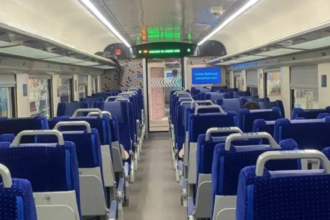


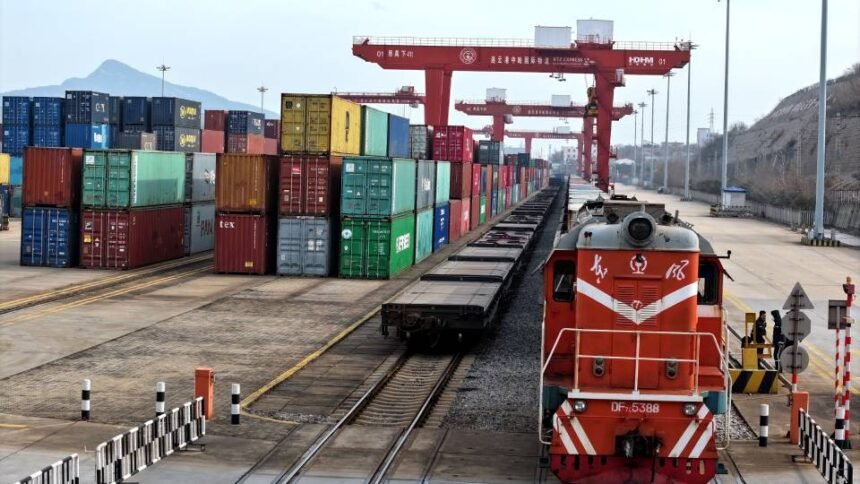
The CASA railway project could establish a new rail link between Central Asia and Pakistani seaports. The proposed route would pass through Kazakhstan, Uzbekistan, Afghanistan and Pakistan.
It could connect regional cargo flows with Karachi, Port Qasim and potentially Gwadar. Consequently, the project could offer Central Asian economies another route to maritime markets.
However, the proposal remains at an early stage. A memorandum signed by Kazakhstan, Uzbekistan and the UAE on September 30, 2026, outlined their intention to develop the route.
The memorandum did not specify the alignment, construction schedule or estimated project cost. Therefore, the CASA railway remains a proposed connectivity initiative rather than a confirmed infrastructure project.
CASA railway could diversify Eurasian trade routes
The proposal comes amid growing concerns over disruptions to major maritime routes. Recent geopolitical tensions and climate-related challenges have affected waterways such as the Black Sea, Red Sea, Strait of Hormuz and Panama Canal.
These disruptions have increased shipping costs and uncertainty across global supply chains. As a result, countries are exploring alternative routes for international freight movement.
Several Eurasian connectivity initiatives have gained attention. These include the Middle Corridor, the Trans-Caspian International Transport Route and the International North-South Transport Corridor.
The CASA railway could add another option by connecting Central Asian markets with ports in Pakistan. However, its commercial viability will depend on cargo volumes, transit tariffs and cross-border arrangements.
Kazakhstan focuses on digital transport infrastructure
Kazakhstan is strengthening the operational systems that support regional connectivity. Its approach focuses on digital transport operations and simplified border procedures.
The country has introduced electronic exchanges of transport permits with Uzbekistan and Kyrgyzstan. Furthermore, it is promoting a single digital corridor to streamline freight movement.
President Kassym-Jomart Tokayev has also declared 2027 the Year of Nationwide Large-Scale Construction. The associated People’s Construction programme aims to modernise national infrastructure.
The government plans to allocate 6.5 trillion tenge, or around $14.3 billion, from the National Fund by 2029. The programme will support social, transport and engineering infrastructure.
Additionally, Kazakhstan is adopting digital platforms and artificial intelligence across transport operations. These include Smart Cargo, Trip Optimizer, Kinetix, the National Video Control System, e-Joldar, Q-Gate and QazETA.
Smart Cargo enables online tracking of international cargo through a single-window platform. Such systems could help simplify documentation and improve visibility across transport corridors.
Kazakhstan has also elevated the transport sector’s political profile. On November 3, Assel Zhanassova became the country’s transport minister and deputy prime minister.
Her background in digitalisation aligns with the government’s focus on technology-led transport development.
Uzbekistan expands logistics hubs and trade corridors
Uzbekistan is pursuing a hub-and-corridor approach to strengthen its regional logistics position. The strategy combines specialised logistics hubs with customs reforms and digital transport systems.
On October 12, President Shavkat Mirziyoyev approved a resolution covering transport and logistics development from 2026 to 2030.
The policy package combines infrastructure investment with tax and customs incentives. It also makes digitalisation a key part of the development programme.
Uzbekistan aims to double transport services and attract $9.1 billion in investment by 2030. Meanwhile, its Digital Uzbekistan 2030 strategy supports electronic permits, digital payments and the E-logistika platform.
The government is also seeking to improve railway management and organise freight movement more efficiently. These measures could strengthen Uzbekistan’s role in regional and international trade.
UAE brings investment and technology interests
The UAE’s participation adds another dimension to the proposed CASA railway partnership. Its involvement could combine financial resources, logistics expertise and digital technology.
The UAE has positioned artificial intelligence and digital transformation at the centre of its economic diversification plans. These priorities also extend to transport and logistics.
The country has pursued technology partnerships with Kazakhstan across several areas. These include data centres, smart road technologies and AI-enabled urban infrastructure.
Additionally, AD Ports Group has partnered with Kazakhstan Railways on industrial infrastructure development. Such cooperation reflects the UAE’s expanding interest in Central Asian transport networks.
The CASA railway could provide another platform for this partnership. However, the extent of UAE investment and technology involvement remains unclear.
Project viability depends on cross-border coordination
The proposed railway could offer Central Asia an alternative connection to maritime trade. Nevertheless, its development will require agreements on infrastructure, financing and border procedures.
The four transit countries must also establish workable arrangements for freight movement and transit tariffs. Furthermore, sufficient cargo volumes will be essential to support the route commercially.
Digital systems could help improve customs processing and transport coordination. However, their adoption across the proposed corridor has not yet been confirmed.
For now, the September memorandum marks an initial step towards developing the CASA railway. Its eventual progress will depend on the countries translating their connectivity ambitions into a defined and commercially viable project.