Indian Railways is developing a new waste management system that could make train journeys cleaner and more hygienic. The prototype increases garbage storage capacity from approximately 18 litres to 367.4 litres. Consequently, passengers could see fewer overflowing dustbins and less litter inside coaches. The system also aims to reduce waste handling during long-distance journeys.
The Wagon Repair Workshop in Jhansi developed the system for Linke Hofmann Busch (LHB) coaches. However, wider implementation depends on inspection and approval by the Research Designs and Standards Organisation (RDSO). Therefore, passengers should not expect an immediate rollout across the railway network.
Indian Railways Waste Management System: How It Works
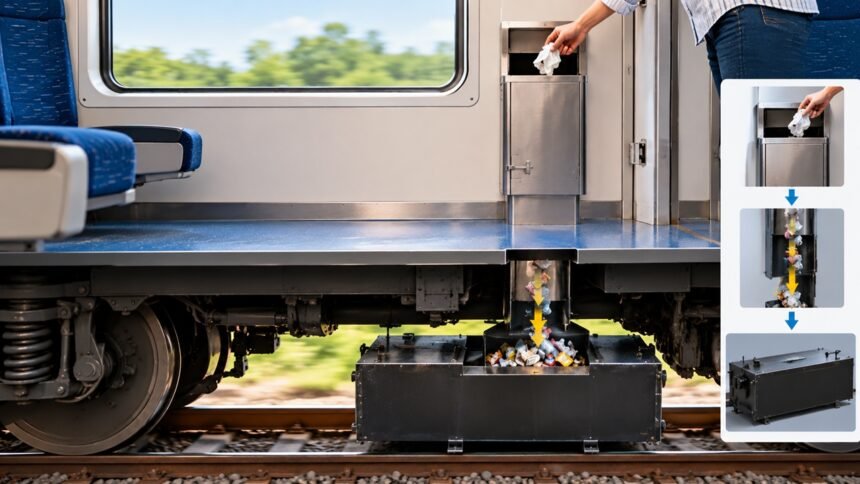
The proposed system uses three components to transfer garbage from passenger areas into a large collector beneath the coach. These components include a garbage drop box, a connector and an undergear collector.
Passengers can dispose of waste through the familiar drop box inside the coach. Meanwhile, gravity carries the garbage through the connector into the collector mounted underneath the train.
This arrangement moves accumulated waste away from passenger areas. Consequently, it could reduce overflowing bins and improve cleanliness during long journeys.
The collector can store garbage until railway staff empty it during maintenance. Thus, the system could reduce the need for repeated manual handling throughout a journey.
Garbage Capacity to Increase More Than 20 Times
The biggest improvement involves the system’s waste-holding capacity.
The existing arrangement has approximately 18 litres of capacity, according to reports. In contrast, the proposed collector can accommodate 367.4 litres.
| Feature | Existing arrangement | Proposed system |
|---|---|---|
| Garbage capacity | Approximately 18 litres | 367.4 litres |
| Waste collection | Limited onboard bins | Drop box and undercoach collector |
| Emptying | Frequent handling may be necessary | Collector emptied during maintenance |
| Construction | Conventional arrangement | Stainless steel collector |
Consequently, the new design offers more than 20 times the reported storage capacity. This increase could help manage the waste generated during lengthy journeys.
Furthermore, the larger collector could reduce garbage overflow when cleaning staff cannot empty bins frequently. It may also discourage passengers from throwing rubbish onto railway tracks.
Stainless Steel Design Aims to Improve Hygiene
The proposed system uses stainless steel to improve durability and resist corrosion. Additionally, its design allows railway staff to remove the collector for emptying and maintenance.
The collector features a specialised taper that facilitates removal. Staff can also clean the drop box and collector independently from both sides.
These features could simplify cleaning procedures and support better sanitation. Moreover, improved waste containment could help control unpleasant odours inside passenger coaches.
However, the system cannot guarantee completely blockage-free operation. Its performance will depend on the design, maintenance practices and the types of waste passengers dispose of.
RDSO Approval Will Determine Wider Implementation
The new Indian Railways waste management system remains subject to technical inspection and approval. Railway officials have submitted the prototype to RDSO for evaluation.
According to reports quoting North Central Railway Chief Public Relations Officer Shivam Sharma, officials will incorporate any modifications recommended during inspection.
Therefore, the railways have not yet confirmed a nationwide deployment schedule. Wider adoption will depend on the approval process and subsequent implementation decisions.
Reports also put the estimated assembly cost at approximately ₹12,000 per unit. Each coach could receive two units, positioned near its exits, under the proposed arrangement.
Cleaner Coaches Could Mean Cleaner Railway Tracks
Overflowing dustbins create problems beyond passenger discomfort. For instance, accumulated rubbish can spread through coaches and encourage littering along railway tracks.
The new system aims to address these challenges through greater storage capacity and improved waste containment. Consequently, it could support cleaner coaches and reduce the frequency of onboard garbage handling.
Indian Railways already operates onboard housekeeping services on identified long-distance trains. Furthermore, its existing waste management measures include collecting garbage at designated stations for appropriate disposal.
The proposed system could complement these efforts by improving how coaches store waste during journeys. Ultimately, effective maintenance, timely disposal and responsible passenger behaviour will remain essential to maintaining railway hygiene.