

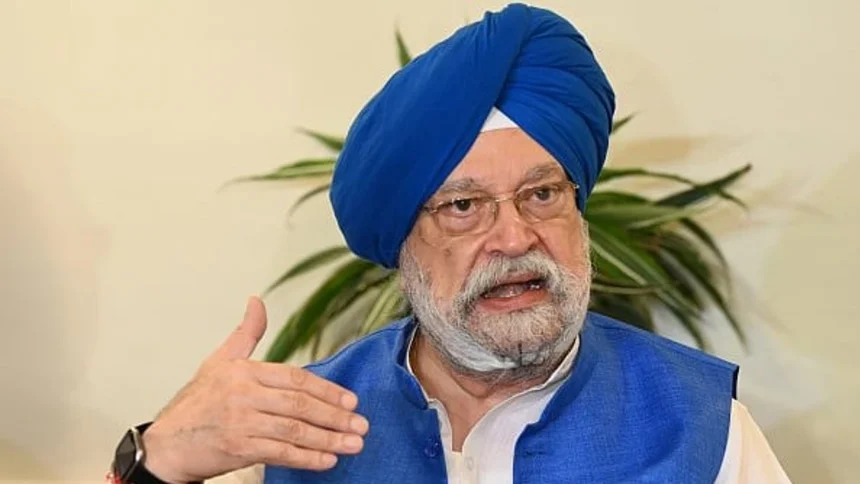
India’s ethanol blending target will remain at 20 per cent for now, Petroleum and Natural Gas Minister Hardeep Singh Puri said on Tuesday. He ruled out any immediate plan to increase the blending level beyond E20 petrol.
Speaking at the inauguration of the 29th Energy Technology and Innovation Meet in Betul village, South Goa, Puri also described claims about E20 fuel causing vehicle damage as misinformation.
The government introduced E20 petrol, which contains 20 per cent ethanol and 80 per cent petrol, as part of its efforts to reduce crude oil imports. India’s dependence on imported crude oil is a major contributor to its current account deficit.
No immediate plan to increase ethanol blending beyond E20
Responding to a question about biofuels, Puri said the government had set a 20 per cent ethanol blending target and did not currently intend to raise it further.
He alleged that misinformation was being deliberately circulated about E20 petrol. The minister referred to social media claims that vehicles had broken down and suggested that the government had stopped selling the blended fuel.
Puri said E20 was compatible with vehicles, while acknowledging that older vehicles manufactured before 2003 had faced some problems.
He also referred to reports of difficulties experienced by some E20 users. According to the minister, transportation of blended fuel may have contributed to some issues because tankers were also used to carry other products.
Puri cites Rs 1.6 lakh crore in savings from E20
The minister said the introduction of E20 petrol had helped India save ₹1.6 lakh crore. Of this amount, ₹1.4 lakh crore was returned to farmers, he claimed.
He said ethanol production had also strengthened the role of farmers in the energy sector, describing them as Urjadata, or providers of energy, alongside their traditional role as Annadata, or providers of food.
Addressing allegations of engine damage, Puri said an automobile manufacturer had filed a case against a person who made such claims. He called the wider criticism of E20 a “contrived narrative”.
The minister also cited the daily number of vehicles visiting fuel stations to argue against widespread engine damage claims. These statements reflected the government’s position on the reported concerns.
New rules allow flex-fuel vehicles running on higher ethanol blends
The comments came a day after the Ministry of Road Transport and Highways notified amendments to the Central Motor Vehicles Rules, 1989, allowing flex-fuel vehicles capable of running on blends of up to E100.
Flex-fuel vehicles can operate on higher ethanol blends, including E85, which contains 85 per cent ethanol and 15 per cent petrol, and E100, which is near-pure ethanol.
Automakers including Toyota, Tata Motors and Hyundai Motor Company are developing flex-fuel vehicles for the Indian market.
The energy technology meet was organised by the Ministry of Petroleum and Natural Gas under the theme “Accelerating Energy Innovation From Research to Commercialisation”. It focused on advancing energy innovation from research towards commercial deployment.