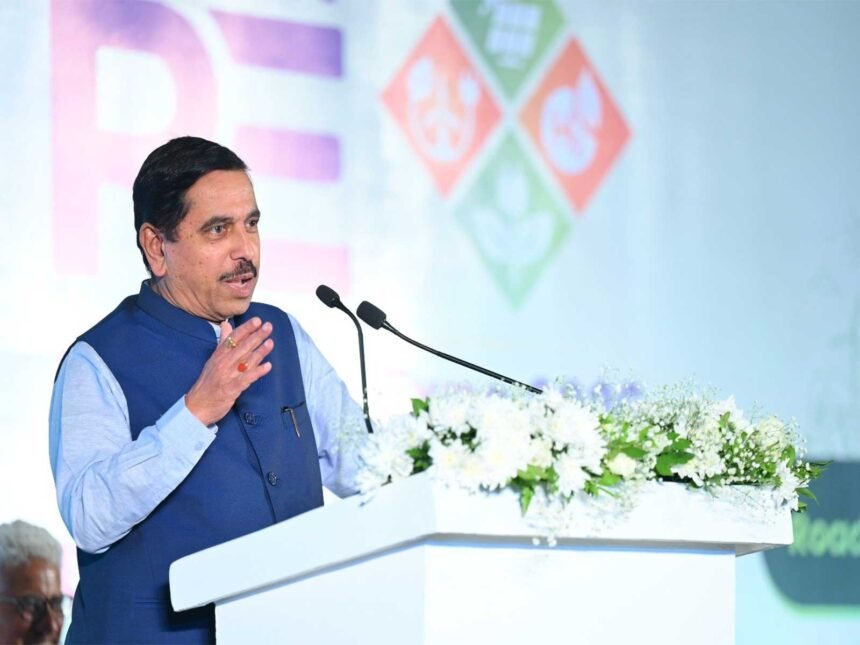
India clean energy investments reached $63.7 billion over the past two years, including $6.2 billion in foreign direct investment (FDI), Union Minister for New and Renewable Energy Pralhad Joshi said on Monday.
Addressing the first day of the Bharat Renewable Energy Summit and Expo (BRES) 2026 at Bharat Mandapam in New Delhi, Joshi attributed the investment growth to rising confidence in India’s renewable energy market and policy framework.
He said India’s installed non-fossil fuel-based power capacity had crossed 310 GW, compared with around 80 GW in 2014. The country is targeting 500 GW of non-fossil fuel-based installed capacity by 2030.
Solar capacity reaches 171 GW, wind expands to 60 GW
Joshi said India’s solar power capacity had increased from 2.8 GW in 2014 to around 171 GW. Wind power capacity rose from 21 GW to approximately 60 GW during the same period.
He highlighted Gujarat’s early role in developing India’s solar energy sector and referred to initiatives undertaken when Prime Minister Narendra Modi was the state’s chief minister.
“While the sun may rise in the East, the dawn of solar energy in India began in the West, in Gujarat,” Joshi said.
He also referred to Gujarat’s initiatives in hydrogen development and solar power generation.
PM Surya Ghar installations cross 65 lakh households
The minister said rooftop solar installations under the PM Surya Ghar: Muft Bijli Yojana had crossed 65 lakh households within two years.
“On average, we are adding more than one lakh installations every six days,” he said.
Joshi called for expanding decentralised solar generation beyond residential rooftops. He identified agricultural land, schools, colleges, hospitals and other public infrastructure as potential areas for adoption.
He also highlighted solar-powered irrigation under PM-KUSUM. The initiative can reduce farmers’ dependence on conventional electricity and create additional income opportunities.
Green Energy Corridor and hydrogen projects gain focus
Joshi said expanding renewable energy capacity would require parallel investments in transmission infrastructure. This would help evacuate electricity from renewable energy generation centres.
He referred to the Green Energy Corridor Phase-III project, highlighting an outlay of Rs 1.86 lakh crore for strengthening renewable energy infrastructure.
The minister also highlighted developments in green hydrogen and green ammonia. He cited prices of Rs 279 per kg for green hydrogen and Rs 49.75 per kg for green ammonia, describing them as among the lowest globally.
He said strengthening domestic capabilities across clean energy technologies would help reduce dependence on imported fossil fuels and improve energy security.
Rising energy demand opens opportunities for clean energy investment
Joshi said India’s projected economic growth of around 7 per cent in 2026-27 would drive higher energy demand. This would increase the need for reliable and sustainable energy supplies.
He said dependence on imported fossil fuels exposed economies to international supply disruptions and price fluctuations. Expanding domestic clean energy sources would help address these risks.
The minister invited global investors, researchers, innovators and entrepreneurs to participate in India’s energy transition.
He identified renewable energy generation, manufacturing, energy storage, green hydrogen and technology development as key areas for investment.
Joshi also called for greater participation from state governments, industry and research institutions in developing indigenous technologies and strengthening India’s clean energy ecosystem.