


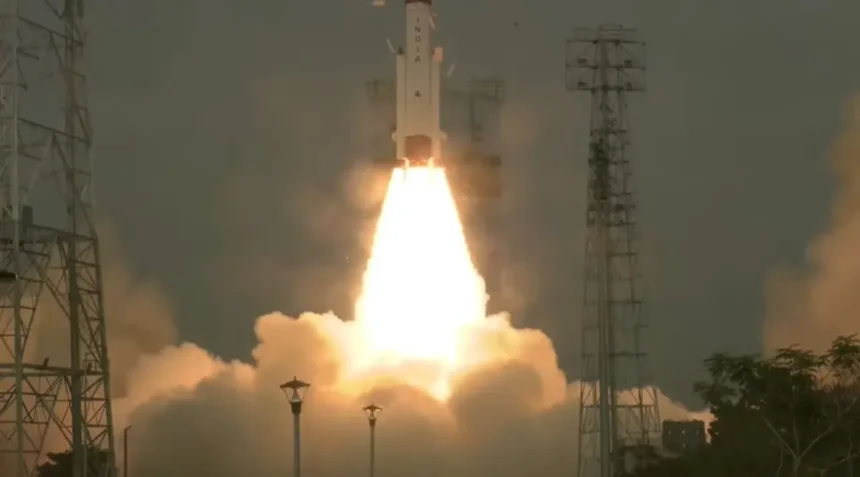
India’s space economy has expanded to approximately $9 billion, up from $8.4 billion in 2023. Meanwhile, registered space startups have increased to 440 from just one in 2014.
The growth reflects rising private-sector participation and investment in India’s space industry, according to a government factsheet.
Cumulative investment in Indian space startups increased more than sixfold. It rose from $100.5 million in FY22 to $618.5 million by March 31, 2026.
The government has also shifted towards a facilitative approach to space-sector governance. Consequently, private enterprises now have greater opportunities to participate in commercial space activities.
India’s space economy gains from private-sector reforms
The government announced major space-sector reforms on June 24, 2020. These reforms aimed to expand private participation and strengthen India’s position in the global space economy.
The Union Cabinet approved measures to establish a collaborative public-private framework. Furthermore, the reforms sought to encourage innovation, investment and entrepreneurship while retaining public-sector leadership.
NewSpace India Limited (NSIL) was established in March 2019 as the Department of Space’s commercial arm. Its mandate was subsequently expanded to commercialise technologies developed using public funds.
NSIL also aggregates demand from government and other customers. Additionally, it markets and sells space technologies and services in domestic and international markets.
NSIL’s revenue increased nearly tenfold, from Rs 321.77 crore in FY22 to over Rs 3,000 crore in FY25. The company has also signed 118 technology transfer agreements covering 83 ISRO technologies.
Private-sector space activities, however, remain subject to applicable licensing, safety and security requirements.
IN-SPACe facilitates private space activities
The reforms also established the Indian National Space Promotion and Authorisation Centre (IN-SPACe) as an autonomous agency.
Operating under the Department of Space, IN-SPACe serves as a single-window interface for private enterprises seeking regulatory clearances. Its responsibilities include authorising and supervising space activities.
It also facilitates access to ISRO facilities, subject to safety considerations and operational priorities. Furthermore, its mandate covers mission safety, launch readiness, orbital and frequency coordination, spacecraft registration and security requirements.
As of January 31, 2026, IN-SPACe had facilitated 71 technology transfers to industry and startups.
By mid-2026, the agency had granted 113 authorisations to 52 non-government entities (NGEs). These included 18 startups.
Six Indian non-government entities launched 18 satellites. Additionally, 25 payloads were flown or scheduled on PSLV Orbital Experimental Module (POEM) platforms.
Space-sector investment and global partnerships expand
Foreign investment proposals have also reflected growing interest in India’s space sector.
By mid-2026, the government had received 11 foreign direct investment proposals worth Rs 1,745.40 crore.
Meanwhile, India’s international space cooperation continued to expand. As of June 2026, the country had over 300 space cooperation agreements.
These agreements covered 61 countries and five multilateral organisations, according to the government factsheet.
The figures underline the expanding role of private enterprises in India’s space programme. Moreover, rising startup investments, technology transfers and international partnerships are widening opportunities across the sector.