


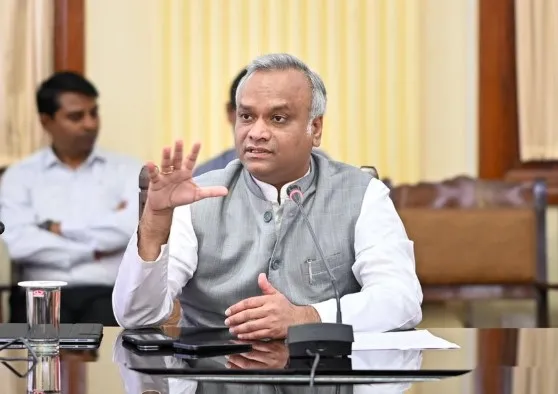
Karnataka GCC investments must expand beyond Bengaluru to strengthen the state’s innovation ecosystem, IT-BT Minister Priyank Kharge said on Wednesday.
He urged global capability centres (GCCs) to invest in other cities, promote industry-led skilling and establish Centres of Excellence. Furthermore, he called on them to mentor startups and collaborate with the government through its ‘Government First’ initiative.
Kharge outlined a five-point agenda at a GCC roundtable organised with Kyndryl. The discussion took place on the sidelines of the 29th Bengaluru Tech Summit 2026.
The agenda aims to position Karnataka as a global destination for innovation, research and development, and intellectual property (IP) creation.
Karnataka attracts over 100 GCCs in nine months
Highlighting the state’s performance, Kharge said Karnataka had attracted more than 100 GCCs during the first nine months of the current financial year.
He attributed this growth to sustained engagement between industry and government. Additionally, he credited India’s first dedicated GCC policy with strengthening Karnataka’s position in India and Asia.
However, he said the sector must move beyond its traditional services-led model. GCCs should increasingly focus on innovation and IP creation, including registering more intellectual property in Karnataka.
The minister also assured industry representatives that the state would urge the Union government to simplify IP filing procedures.
Five-point agenda for GCC investments beyond Bengaluru
Kharge asked GCCs to explore investment opportunities in cities beyond Bengaluru. He said companies could leverage local talent while strengthening infrastructure and business ecosystems across Karnataka.
Furthermore, he urged GCCs to partner with the government’s Rs 300-crore Nipuna programme. Companies can contribute by designing industry-aligned curricula and supporting training in frontier technologies.
The minister also proposed industry-led Centres of Excellence in emerging sectors. These include life sciences, healthcare, aerospace and logistics.
He called on GCCs to support startups, particularly deeptech ventures. Their expertise, mentorship, incubation capabilities and industry networks could help these businesses scale.
Additionally, he invited companies to identify startup solutions for public-sector challenges. They could also help deploy these solutions through the government’s Government First initiative.
AI, deeptech and engineering skills in focus
During the interactive discussion, Kharge said deep domain expertise would help GCCs move up the value chain. This would become increasingly important as artificial intelligence transforms industries, according to a government statement.
He said Karnataka’s deeptech strategy focused on converting scientific and engineering capabilities into practical applications.
Citing the state’s strengths in aerospace, space technology and advanced research, he highlighted opportunities for cross-sector technology adoption. For instance, technologies developed for space applications could support automotive engineering and industrial Internet of Things applications.
Meanwhile, Kharge addressed concerns around engineering education and talent development. He stressed the importance of strengthening pure sciences and core engineering disciplines alongside computer science.
The government was working to foster scientific temperament from the school level, he said. Consequently, this approach aims to build stronger foundations for innovation, research and advanced manufacturing.
Kharge also encouraged global companies to consider Karnataka for greater decision-making responsibilities, research activities and global operations. The proposed collaboration seeks to expand the state’s GCC ecosystem beyond its established Bengaluru base.