

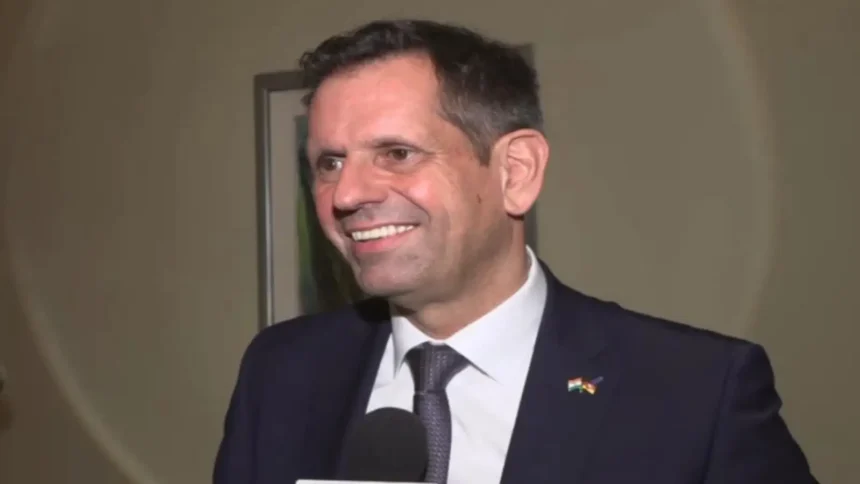
India-EU FTA investment opportunities could expand trade, business partnerships and employment across both regions, Lower Saxony Minister-President Olaf Lies said. He expressed confidence that India and the European Union would reach a final agreement by the end of 2026.
Negotiations between India and the 27-member European bloc concluded in January. The agreement is expected to be signed in December.
The proposed deal could benefit German companies seeking investments in India. It could also help Indian businesses explore opportunities in Germany, Lies told PTI on Monday.
He is leading a delegation of around 60 political and business representatives on an official visit to India. The delegation includes members of the Lower Saxony state parliament and business leaders.
Lower Saxony eyes stronger India business partnerships
The delegation began its visit on Monday and is scheduled to hold meetings in Delhi, Pune and Mumbai.
Speaking at the German Embassy in New Delhi, Lies described the proposed FTA as an opportunity to expand investment and trade.
“The FTA is a big chance for more investment, for more trade, for more business between our countries,” he told PTI.
He added that Lower Saxony was open to Indian workers and businesses. Similarly, he said companies from his state were keen to explore opportunities in India.
Lower Saxony, located in northwestern Germany, is home to automotive major Volkswagen. The company is headquartered in Wolfsburg and has an established manufacturing and development presence in India.
Furthermore, Lies identified digitalisation, artificial intelligence and emerging technologies as areas for cooperation. He said India was not merely a market for German companies but also a technology and innovation partner.
In his embassy address, Lies said India and Germany shared an interest in open trade, technology serving people and a rules-based international order.
He added that reliable partnerships had become increasingly important amid global uncertainty.
Germany seeks skilled Indian workers
Employment and workforce mobility also featured prominently during the delegation’s discussions. Lies said Lower Saxony wanted to create opportunities for skilled young Indians.
“There are a lot of young people, skilled young people, and maybe it is possible to give them a chance in Lower Saxony to get jobs, to be part of the economy of Lower Saxony,” he said.
He also emphasised the role of education, vocational training and skills development in strengthening bilateral ties.
German Ambassador to India Jasper Wieck described the delegation as one of the most significant state-level groups he had hosted since taking charge around four months ago.
The delegation includes representatives from Germany’s small and medium-sized businesses, commonly known as the Mittelstand.
During the visit, Lies met Skill Development and Entrepreneurship Minister Jayant Chaudhary and Commerce Secretary Rajesh Agrawal.
Telangana, Lower Saxony advance skilled workforce mobility
Separately, Telangana is seeking to strengthen its partnership with Lower Saxony to facilitate employment opportunities for skilled workers.
The two sides are working on vocational training, workforce mobility and structured migration pathways for young people from Telangana.
They exchanged a Letter of Intent in April. Subsequently, they held a talent mobility roundtable on Monday.
Telangana Labour Minister Vivek Venkataswamy said the state government would invest in training candidates before they move to Germany.
The training would cover German language, culture and workplace practices. The government also aims to prepare the first group of workers for successful placements.
Venkataswamy said the initial placements could help establish a pathway for more candidates to follow.
The developments reflect growing cooperation between German states and Indian partners on business, technology and skilled workforce mobility. The proposed India-EU FTA could provide a wider framework for expanding these exchanges.