


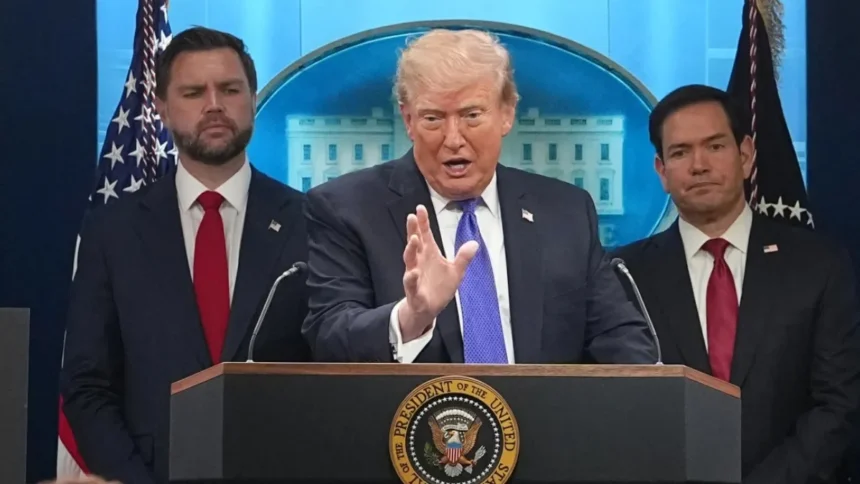
Microsoft has defended its overseas data centres after US President Donald Trump threatened penalties against companies building facilities abroad.
Microsoft President Brad Smith said cloud infrastructure must remain close to customers. He argued that data centres serving everyday digital services cannot simply relocate to the United States.
Speaking on CBS’s Face the Nation, Smith distinguished between facilities training advanced artificial intelligence models and those providing regular cloud services.
He said the administration could discuss keeping advanced AI model training within the United States. However, he cautioned against treating all data centres alike.
Microsoft highlights need for local cloud infrastructure
Smith said most data centres support cloud services rather than train advanced AI systems. These facilities enable video streaming, gaming and business applications.
Furthermore, cloud services increasingly include AI-powered features across business applications and video games. Therefore, providers need infrastructure close to their customers.
Using Finland as an example, Smith said facilities serving overseas users could not be replaced by installations in America.
He compared the arrangement to electricity generation, arguing that a power plant in New Jersey could not supply Helsinki. Similarly, US-based infrastructure cannot adequately support every overseas cloud customer.
Smith described Trump’s concerns as important but requiring greater policy nuance. He said advanced AI development and local cloud infrastructure involved different considerations.
Trump threatens penalties for overseas data centre investments
Trump said during a Friday news conference that the United States would not allow data centres to move abroad. He also threatened “tremendous penalties” against companies pursuing such investments.
However, Treasury Secretary Scott Bessent said he had not discussed the proposal’s details with Trump. Bessent told CBS that he had attended the news conference but had not spoken with the president afterwards.
Bessent interpreted Trump’s concerns as an effort to prevent major technology transfers overseas. He compared the issue with semiconductor manufacturing.
He argued that dependence on overseas chip production had created strategic vulnerabilities. Consequently, the administration wants to address similar concerns across critical technology infrastructure.
Bessent also urged technology companies to explain their investment plans more clearly. He said firms needed to rebuild trust with communities hosting data centres.
Microsoft’s India investment puts policy debate in focus
The debate has implications for India, where Microsoft announced a $17.5 billion investment programme in December 2025.
The commitment covers 2026-2029 and focuses on cloud and AI infrastructure, skills development and ongoing operations. It builds on an earlier $3 billion investment commitment.
Microsoft also outlined plans to expand its data centre regions in Chennai, Hyderabad and Pune. However, the announced investment represents a multiyear commitment, not expenditure already completed.
Neither Smith nor Bessent identified India as a target of the proposed restrictions. Smith also did not announce any changes to Microsoft’s India investment plans.
His central argument was that advanced AI development and overseas cloud operations require separate policy considerations. Keeping frontier AI training in America does not necessarily mean relocating infrastructure serving international customers.