
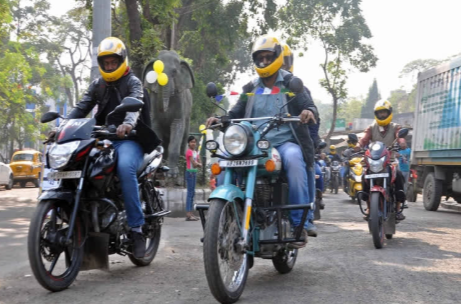
Union Minister Nitin Gadkari has urged states to implement the Motor Vehicle Aggregator Guidelines 2025. The guidelines allow states to permit private motorcycles for passenger rides through aggregator platforms.
Addressing the programme ‘RIDE: A Showcase of Aggregator and Delivery Services’ on Wednesday, Gadkari said implementation remained limited. Only Rajasthan has fully implemented the guidelines, while Haryana and Uttar Pradesh have adopted them partially.
The minister said he had called transport commissioners across states. He urged them to take the initiative and permit private motorcycles for passenger services through aggregators.
He also said he had written to state governments regarding the implementation. The appeal seeks wider adoption of the framework across the country.
Gadkari highlights employment potential of bike taxis
Gadkari linked the wider adoption of bike taxis with employment generation and economic growth. He said poverty, unemployment and socio-economic backwardness remained challenges across the country.
“Why should not we provide people with employment opportunities so that they can live with dignity and self-respect?” he asked.
The minister said allowing private motorcycles on aggregator platforms could create substantial livelihood opportunities. He estimated that 15-20 crore people could benefit if all states adopted the framework.
Furthermore, Gadkari highlighted the potential social benefits of expanding employment opportunities. He said higher incomes could help reduce poverty and improve access to education and housing.
He also stressed the importance of enabling people to earn livelihoods with dignity. According to him, such opportunities could contribute to broader economic growth.
MVAG 2025 provides regulatory clarity for private motorcycles
The Ministry of Road Transport and Highways issued the Motor Vehicle Aggregator Guidelines 2025 in July. The framework allows state governments to permit non-transport motorcycles for passenger journeys through aggregators.
Under the guidelines, states can exercise their powers under Section 67(3) of the Motor Vehicles Act, 1988. They can allow private motorcycles to operate as shared mobility services through aggregator platforms.
The framework identifies several potential benefits of the move. These include reduced traffic congestion, lower vehicular pollution and affordable passenger mobility.
Additionally, the guidelines recognise opportunities in hyperlocal delivery and livelihood generation. They also seek to balance a light-touch regulatory approach with user safety and driver welfare.
The provisions offer regulatory clarity to bike taxi operators such as Rapido and Uber. These companies have faced legal uncertainty in several markets, including Karnataka, where restrictions triggered protests and tensions.
Revised guidelines reflect changes in shared mobility
The government first issued the Motor Vehicle Aggregator Guidelines in 2020 under Section 93 of the Motor Vehicles Act, 1988.
Since then, India’s shared mobility ecosystem has undergone significant changes. Demand has expanded across bike-sharing, electric vehicles and auto-rickshaw services.
The ministry revised the 2020 framework to address these developments. The updated guidelines aim to keep regulations aligned with changing aggregator business models and mobility requirements.
However, implementation remains dependent on individual state governments. Gadkari’s latest appeal seeks to encourage more states to adopt the provisions and expand private motorcycle-based passenger services.