

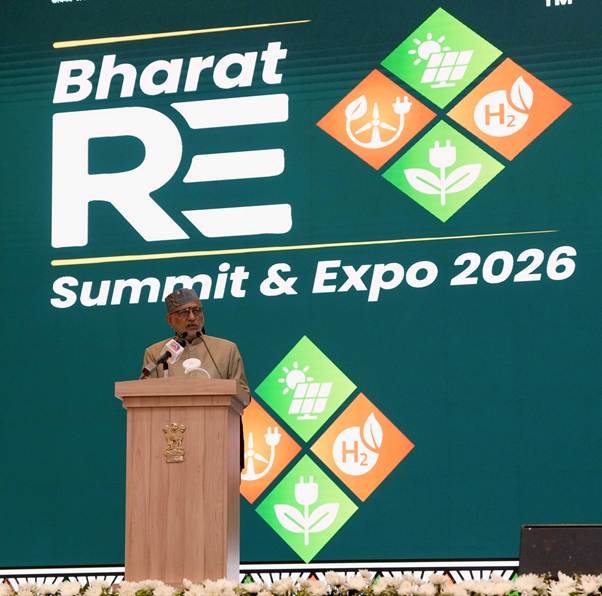
India’s transition towards renewable energy demonstrates that environmental commitments and economic growth can advance together, with clean energy emerging as a catalyst for national development, Vice-President C P Radhakrishnan said on Thursday.
Addressing the valedictory session of the Bharat Renewable Energy Summit & Expo (BRESE) 2026 in New Delhi, Radhakrishnan said India’s renewable energy achievements over the past decade had established a strong case for integrating sustainability with economic progress.
He highlighted how the expansion of clean energy was improving energy access, reducing industrial costs, creating employment opportunities and lowering the country’s dependence on fossil fuel imports.
The Vice-President said the progress reflected Prime Minister Narendra Modi’s vision of making environmental commitments an enabler of development rather than a constraint on economic growth.
Calling for closer collaboration between industry and academic institutions, Radhakrishnan underlined the importance of research, innovation and entrepreneurship in shaping India’s future energy landscape.
“The technologies of 2040 will come from the laboratories and start-ups of today,” he said, stressing the need to strengthen the country’s innovation ecosystem.
Renewable energy investment gains momentum
Union Minister for New and Renewable Energy Pralhad Joshi, who also addressed the gathering, said India’s renewable energy sector had attracted investments exceeding ₹15 lakh crore over the past decade. Nearly ₹6 lakh crore of this investment had come in the last two years.
Joshi described BRESE 2026 as India’s largest renewable energy event, with more than 75,000 visitors from 135 countries. The summit brought together over 32 international ministers, more than 400 exhibitors, 620 speakers and participants across 113 sessions.
The event also hosted the ninth International Solar Alliance Assembly and the fourth International Conference on Green Hydrogen.
Highlighting the sector’s investment potential, Joshi said commitments worth USD 400 billion (around ₹37.85 lakh crore) were made at the CEO Roundtable. He also highlighted a proposed $200 million Africa Solar Facility under the International Solar Alliance.
India advances energy storage and manufacturing capacity
The minister highlighted the Union Cabinet’s approval of a ₹14,500 crore Viability Gap Funding scheme for developing 92 GWh of grid-scale energy storage capacity.
The proposed capacity includes 30 GWh of battery energy storage systems, 60 GWh of pumped storage projects and 2 GWh through emerging technologies.
Joshi also said India’s utility-scale solar generation costs had fallen to USD 30-35 per MWh, among the lowest globally. Renewable energy deployment had helped the country save more than $100 billion in fossil fuel imports.
On manufacturing, he said India’s solar module production capacity had crossed 225 GW, positioning the country as the world’s second-largest solar module manufacturer.
He added that distributed solar capacity for self-consumption was expected to exceed 100 GW by 2030.
India also auctioned 15 GW of hybrid renewable energy projects in 2025, taking cumulative auctioned capacity to 64 GW. Both figures represented the highest volumes globally, according to the minister.
Transmission infrastructure and AI emerge as priorities
Joshi emphasised that expanding renewable energy capacity would require parallel investments in transmission infrastructure, energy storage and smarter electricity grids.
He identified digitalisation and artificial intelligence as important tools for renewable energy forecasting, predictive maintenance and energy management.
The minister further noted that AI data centres could add 26.3 GW to India’s electricity demand by 2031-32. He stressed the need to plan for this additional requirement while ensuring renewable energy remains central to meeting future demand. “AI will power the future. Clean energy will power AI,” he said.
The summit also witnessed the participation of around 800 international delegates and the signing of 10 memoranda of understanding and framework agreements. These included an agreement involving SECI with the potential to facilitate the supply of three lakh tonnes of green methanol annually.
Minister of State for New and Renewable Energy and Power Shripad Yesso Naik, Principal Scientific Adviser to the Government of India Ajay Kumar Sood and MNRE Secretary Santosh Kumar Sarangi were among those present.
Representatives of partner countries, policymakers, investors, industry leaders and international delegates also attended the valedictory session.