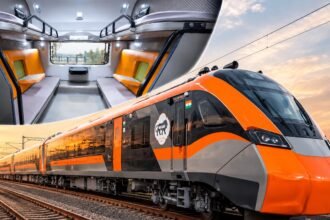


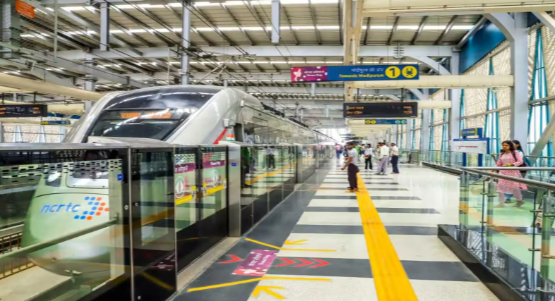
The Gurugram Faridabad Greater Noida Namo Bharat corridor has moved forward with NCRTC finalising its Detailed Project Report (DPR). The proposed 61-64 km hybrid network will connect four major urban centres across Haryana and Uttar Pradesh.
The National Capital Region Transport Corporation has proposed a combination of Regional Rapid Transit System (RRTS) and metro services. Both services would operate along the same corridor, according to a report by Noida Khabar.
The project carries an estimated cost of Rs 15,000 crore to Rs 19,390 crore. Around 50-52 km of the alignment would fall in Haryana. The remaining 12-13 km would pass through Uttar Pradesh.
The proposed network includes around 22 stations. However, the station breakdown in the report lists eight RRTS stations and approximately 15 metro stations.
IFFCO Chowk to Surajpur: Proposed Namo Bharat route
The corridor would begin at IFFCO Chowk in Gurugram. The station is proposed as an interchange with the Delhi-Bawal Namo Bharat corridor.
It would terminate at Surajpur in Greater Noida. Surajpur is also proposed as an interchange with the Ghaziabad-Jewar Airport Namo Bharat corridor.
The proposed RRTS stations include:
- IFFCO Chowk, Gurugram
- Sector 61, Gurugram
- Gwal Pahari, Gurugram
- Sainik Colony, Faridabad
- Bata Chowk, Faridabad
- Sector 87-88 junction, Faridabad
- Noida Sector 142
- Surajpur, Greater Noida
Bata Chowk would provide an interchange with the existing metro network. Meanwhile, the report also identifies the Sector 168 area as a possible entry point.
Metro stations proposed across three cities
The hybrid corridor would also include approximately 15 metro stations. These would serve residential and commercial areas across Gurugram, Faridabad and Noida.
In Gurugram, the proposed stations include Sector 29, Millennium City Centre, Sector 52/52A, Wazirabad and Sector 57.
Faridabad’s proposed stations include NIT-3, NIT-1 and the Sector 12-15 crossing. The list also covers Sector 80, Sector 81-82 crossing, Sector 85-86 crossing and Badshahpur.
In Noida and Greater Noida, the proposed stations include Sector 135, Sector 141 and the Suthiana-Surajpur area.
The alignment would pass through Millennium City Centre and Brigadier Usman Chowk. It would then reach Gwal Pahari before entering Faridabad through the Gurugram-Faridabad Road (MDR-137).
The route would continue towards Hanuman Mandir and Badkhal Enclave. It would then pass through Shaheed Bhagat Singh Marg and Bata Chowk.
Furthermore, the corridor would use the Faridabad-Noida-Ghaziabad (FNG) Expressway to enter Noida. It would serve the Sector 142 and Sector 168 areas before reaching Surajpur.
Project awaits final approvals
The Haryana government has approved the proposed alignment and design, according to the report. NCRTC has forwarded the DPR for further consideration by state governments and the Centre.
However, the project still requires the necessary final approvals. Construction could begin by late 2026 or during 2027, subject to clearances.
The proposed corridor could reduce travel times across the region. The report estimates a journey of around 40 minutes between Gurugram and Noida.
Travel between Gurugram and Faridabad could take approximately 20 minutes. This compares with an estimated 1.5-2 hours by road.
The corridor is also expected to strengthen connectivity with the upcoming Jewar airport. Its proposed interchange at Surajpur could connect the network with the Ghaziabad-Jewar Airport corridor.
Once approved and implemented, the project could add another rapid transit link across the wider National Capital Region.