

Six Kathipara Junction Metro trains are expected to operate simultaneously by March 2027. The development will bring together three corridors across Chennai Metro Rail Limited’s (CMRL) Phase I and Phase II networks.
The milestone follows completion of a critical elevated viaduct section at the junction. CMRL has also started track work along the newly constructed stretch.
The 14.5-km Koyambedu-Alandur section forms part of Phase II’s Corridor 5. This corridor connects Madhavaram and Sholinganallur through Alandur.
Kathipara Junction viaduct construction completed
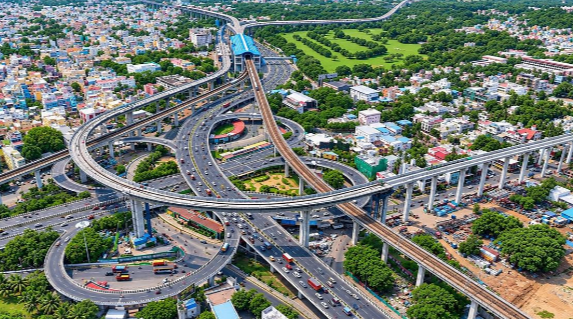
CMRL has completed the 413-metre circular span built using the balanced cantilever method. The structure passes above the Kathipara cloverleaf flyover and two operational Phase I corridors.
The viaduct extends from Paul Wells Road to Alandur. Its supporting pillars range from 88 feet to 108 feet in height.
The tallest pillar stands at 108 feet, among the highest in the CMRL network. Additionally, the new alignment features a sharp curve with a radius of 125 metres.
CMRL adopted the balanced cantilever construction method to avoid major traffic diversions. The technique allowed engineers to construct the viaduct without requiring heavy lifting equipment.
Track installation has now started on the completed section. An official said the work would take around 45 days.
Furthermore, CMRL expects to begin train trials on the stretch by early January 2027. The six-train operation at Kathipara Junction is targeted for March 2027.
Complex construction delays Phase II viaduct work
The viaduct was originally scheduled for completion in February 2026. However, construction faced several challenges over nearly three years.
Limited working-hour permissions restricted the available construction window. The proximity of the new structure to operational Phase I corridors also complicated the work.
Engineers carried out in-situ construction of individual viaduct segments above the cloverleaf flyover. Moreover, stressing the curved concrete segments required additional technical effort.
Officials said the steep alignment increased friction-related difficulties during stressing operations. The construction team also faced electrical induction concerns.
The worksite was close to high-voltage lines and Phase I’s overhead electrical equipment. Consequently, CMRL switched off the Phase I overhead equipment between midnight and 4 am.
This left construction teams with only four hours each night for the work. These restrictions contributed to delays in completing the elevated structure.
Phase II corridor to strengthen Chennai Metro connectivity
The Koyambedu-Alandur stretch forms part of the 118.9-km Phase II network. Its completion will extend Metro connectivity through a key transport junction in Chennai.
Once operational, the new section will allow trains from Koyambedu to travel over the elevated Kathipara structure towards Alandur. Meanwhile, the two existing Phase I corridors will continue operating through the junction.
The planned simultaneous movement of six trains will mark a significant operational milestone. It will also demonstrate the integration of Chennai Metro’s expanding Phase II infrastructure with its existing network.