

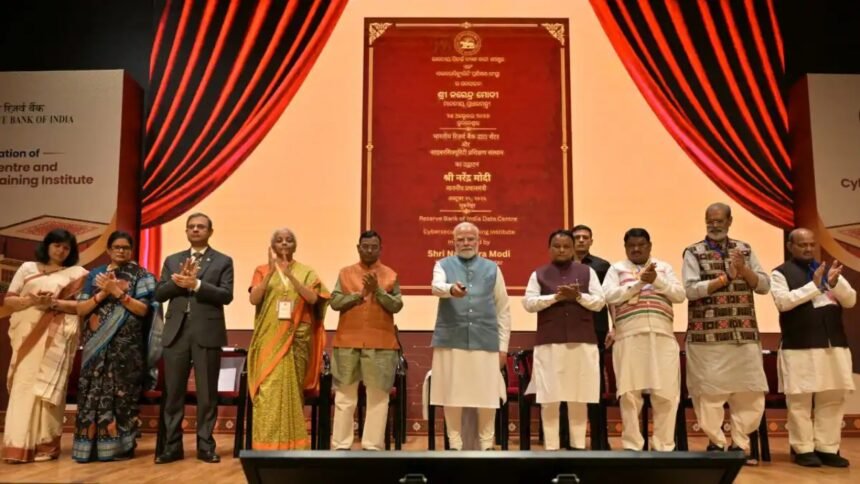
Prime Minister Narendra Modi inaugurated the RBI Data Centre and Cybersecurity Training Institute in Bhubaneswar, Odisha, on October 25, highlighting the need to strengthen digital infrastructure and protect India’s banking system from cyber threats.
The newly established facilities are intended to support the Reserve Bank of India’s computing infrastructure and cybersecurity capabilities. Modi said the institutions would benefit Odisha and the country by strengthening financial security as digital banking expands.
“Nowadays, wars are not fought with weapons alone. A nation can also be weakened by attacking its economy,” the Prime Minister said. He stressed that India must protect its banking system from cybercriminals and cyber terrorists as its economy grows.
RBI cybersecurity institute to strengthen banking security
Modi said the country’s banking priorities were shifting from expanding access to improving efficiency and reliability.
“The past decade was about taking banking to those who were deprived of it. The coming decade is about making banking more efficient and more reliable,” he said.
The Prime Minister highlighted the role of modern computing systems, specialised training and skilled personnel in responding to evolving cyber threats. He said the new cybersecurity institute would help address the need for updated training infrastructure and capabilities.
The inauguration comes as digital transactions and online banking services have expanded across India, increasing the importance of protecting financial systems and customer data.
Digital banking and financial inclusion
The Prime Minister also outlined the expansion of formal banking and digital financial services. He said digital banking had connected people across the country to round-the-clock banking services.
According to Modi, nearly 60 crore Jan Dhan accounts had been opened, helping extend banking access to previously underserved sections of the population. He said direct transfers had enabled government assistance to reach beneficiaries’ bank accounts.
He also cited the role of the Pradhan Mantri Mudra Yojana in supporting first-time entrepreneurs, alongside PM SVANidhi and PM Vishwakarma, which provide formal credit access to street vendors and traditional artisans.
The Prime Minister said Self-Help Groups representing 10 crore rural women had also received bank assistance. He credited the banking sector and its employees for supporting the expansion of financial inclusion.
Social security schemes extend financial protection
Modi highlighted the reach of government-backed social security schemes, including the Atal Pension Yojana, Pradhan Mantri Suraksha Bima Yojana and Pradhan Mantri Jeevan Jyoti Bima Yojana.
He said the Atal Pension Yojana covered nine crore citizens, including 38 lakh people in Odisha. He also referred to insurance benefits available through low-premium accident and life insurance schemes.
According to the Prime Minister, more than Rs 25,000 crore in claims had been disbursed under the cited insurance schemes, providing financial assistance to families during difficult circumstances.
Odisha’s role in India’s digital infrastructure growth
The Prime Minister described eastern India as an important contributor to India’s economic development. He pointed to Odisha’s potential to expand beyond traditional mineral-based industries into semiconductors, electronics, data centres and advanced computing.
He said these emerging sectors could create opportunities for the state’s youth and support its industrial development.
The inauguration of the RBI’s two facilities in Bhubaneswar adds to the state’s presence in India’s financial and digital infrastructure ecosystem, while reinforcing the need for cybersecurity preparedness as banking services become increasingly technology-driven.