


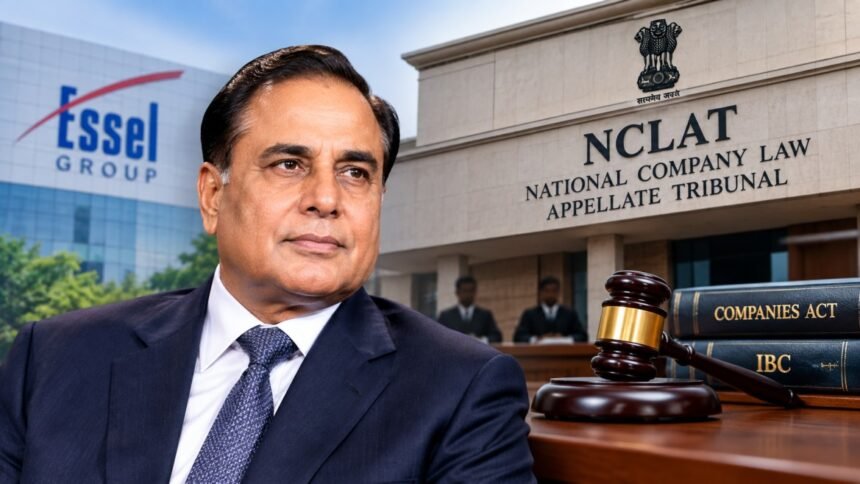
Subhash Chandra moves NCLAT
Essel Group founder Subhash Chandra has approached the National Company Law Appellate Tribunal (NCLAT) against a five-member Bench of the National Company Law Tribunal (NCLT), challenging its decision to put his repayment plan on hold and restrict him from transferring or otherwise alienating his properties.
The appeal was heard by a three-member NCLAT Bench, which directed Chandra’s counsel to serve copies of the petition on the creditors and formally implead them in the proceedings.
The Bench, comprising Officiating Chairperson Justice Yogesh Khanna (retd) and Technical Members Barun Mitra and Ajai Das Mehrotra, has listed the matter for further hearing on September 29.
Creditors seek copies of appeal
During the hearing, lawyers representing the creditors told the tribunal that they had neither received advance copies of the appeal nor been made parties to the proceedings, despite having participated in the earlier NCLT proceedings.
NCLAT consequently directed Chandra’s counsel to complete the required procedural steps before the next hearing.
Chandra questions five-member NCLT Bench
In his appeal, Chandra has challenged the constitution of the five-member NCLT Bench itself. He has argued that the order passed by the tribunal “travels beyond the limited statutory jurisdiction contemplated” under the Companies Act, 2013.
The challenge stems from the NCLT’s September 1 order, which stayed the operation of its earlier decision approving Chandra’s repayment plan.
The five-member Bench decided to reconsider the matter after finding that the earlier proceedings had not produced a clear majority view.

Property transfer restrictions imposed
The five-member Bench, headed by NCLT President Justice Anupinder Singh Grewal (retd), also restrained Chandra from directly or indirectly alienating his properties.
The restriction followed a request by Solicitor General Tushar Mehta, who represented the creditors in the proceedings.
How the repayment plan dispute began
The insolvency proceedings against Chandra were initiated by Indiabulls Housing Finance Ltd. The case subsequently saw conflicting decisions over his proposed repayment plan.
An original two-member NCLT Bench delivered a split verdict. The matter was then referred to Judicial Member Nilesh Sharma under Section 419(5) of the Companies Act, 2013.
On August 25, Sharma approved the repayment plan under Section 114 of the Insolvency and Bankruptcy Code (IBC). He directed that certain claims filed on behalf of 960 and 300 individuals be excluded from the plan.
The amount allocated to those claims was ordered to be redistributed among the remaining eligible creditors.
Sharma also held that the approved repayment plan would be binding on all creditors, including those who had opposed it.
NCLT later orders fresh hearing
When the matter returned to the original two-member Bench, it observed that the differences between the members remained unresolved and that no majority decision had emerged.
With the issue still unsettled, the case was placed before the NCLT President, who constituted the five-member Bench to hear the proceedings afresh.
Dispute over ₹22,006 crore claims
The case has drawn attention because of the significant gap between the creditor claims admitted in the proceedings and the amount proposed to be paid under Chandra’s repayment plan.
Several creditors, including financial institutions, have opposed the plan and questioned the recovery proposed under it.
Chandra, however, has disputed descriptions of the proceedings as a large-scale personal debt write-off. He has maintained that he was a personal guarantor for loans taken by borrowing entities linked to the wider Essel Group and was not himself the borrower of those funds.
He has also argued that the ₹22,006 crore figure represents claims filed in the proceedings and should not be treated as his personal outstanding debt.