


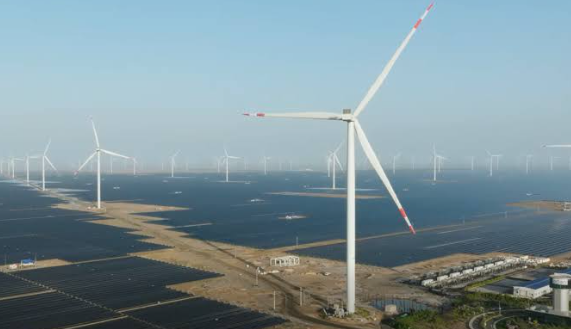
India’s onshore wind energy potential is estimated at 2,933.9 GW at a hub height of 200 metres, significantly higher than previous estimates, according to a study by The Energy and Resources Institute (TERI).
The study places the country’s theoretical onshore wind potential at 1,209.7 GW at a hub height of 150 metres. It also estimates offshore wind potential at approximately 220 GW and 277 GW, respectively, at a minimum wind speed of 7.0 metres per second.
The assessment identifies priority areas for further wind resource validation and outlines pathways to strengthen project development, supporting infrastructure and industry capabilities.
India’s installed wind capacity stood at 59.20 GW as of September 30, 2026. The country added around 6.05 GW during FY26, marking a record annual addition.
Five states account for nearly 79% of onshore potential
Rajasthan, Gujarat and Karnataka account for approximately 61 per cent of India’s estimated onshore wind potential at a hub height of 150 metres.
Including Maharashtra and Tamil Nadu raises the combined share of these five states to nearly 79 per cent.
The findings highlight the concentration of estimated wind resources across these states. TERI said more detailed spatial assessments could help determine where additional capacity can be developed.
The report also identified areas requiring further resource validation to support wind project planning and investment decisions.
Wind capacity could reach 891 GW by 2070
The study’s electricity-transition scenario projects an approximately 11-fold increase in India’s on-grid electricity demand by 2070.
Under its net-zero scenario, wind power capacity could reach 891 GW by that year. The projection reflects one set of assumptions around technology costs and power system requirements.
The report said improved understanding of wind resources could inform generation planning, renewable energy procurement and transmission investment as electricity demand increases.
More spatially detailed assessments could also help identify the infrastructure required to support future renewable energy deployment, including transmission networks, flexibility solutions and manufacturing capabilities.
TERI identifies six pathways for wind industry development
The study outlines six pathways for the utilisation and expansion of India’s wind energy resources:
- Greenfield onshore development: Developing new wind projects in areas with identified potential.
- Repowering existing wind farms: Replacing or upgrading equipment at operational sites to improve generation.
- Higher-hub-height wind development: Using taller turbines to access stronger or more consistent wind resources.
- Wind-solar-storage integration and industrial procurement: Combining renewable generation and storage while supporting industrial electricity demand.
- Fixed-bottom offshore wind: Developing offshore projects using fixed foundations.
- Floating offshore wind: Exploring floating platforms for offshore wind development in suitable locations.
The report said these pathways could support the expansion of India’s wind sector and help identify investment requirements across project development, infrastructure and industry capabilities.