


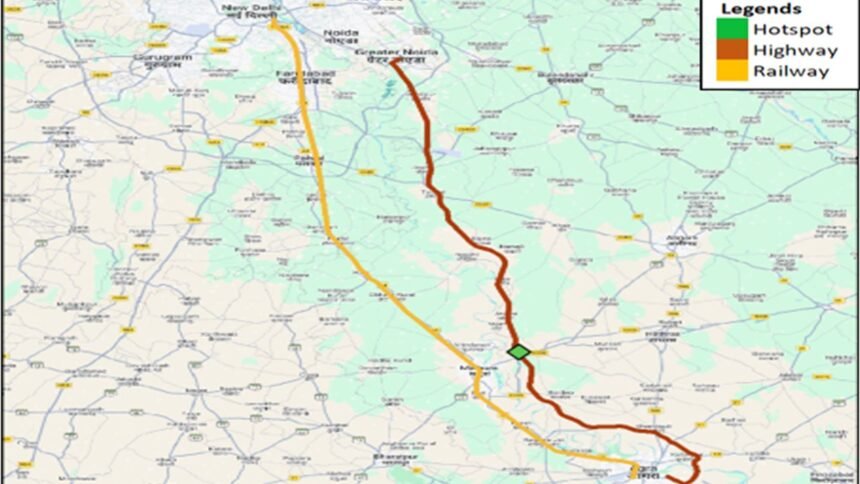
The Telecom Regulatory Authority of India released its latest test results for key transit routes. Specifically, the regulatory audit evaluated major telecom operators on the Yamuna Expressway and Agra-Delhi rail line. Officials conducted independent drive tests during July 2026 to verify real-world network performance for commuters.
Expressway performance highlights stark operator gap
Network testing covered 183.4 kilometers along the Yamuna Expressway. Consequently, tests captured voice and data performance across major commuter transit zones. Furthermore, Reliance Jio registered the fastest average 5G download speed at 213.68 Mbps. Bharti Airtel followed with 135.33 Mbps average download speed. Meanwhile, Vodafone Idea recorded 46.48 Mbps. Conversely, BSNL delivered 8.10 Mbps on its 4G network.
| Telecom Service Provider (TSP) | Avg Download Speed (5G/4G) | Avg Upload Speed (5G/4G) | Dropped Calls Ratio | Call Silence Instances |
| Reliance Jio (RJIL) | 213.68 Mbps | 20.62 Mbps | 1 / 66 | 0 / 68 |
| Bharti Airtel | 135.33 Mbps | 17.62 Mbps | 2 / 65 | 16 / 63 |
| Vodafone Idea (VIL) | 46.48 Mbps | 13.70 Mbps | 0 / 66 | 18 / 68 |
| BSNL | 8.10 Mbps | 3.38 Mbps | 16 / 68 | 2 / 57 |
Voice call reliability varied significantly among providers along the expressway. Vodafone Idea maintained zero dropped calls out of 66 test attempts. However, Airtel recorded 16 call silence instances during voice calls. BSNL showed major coverage gaps, recording 4,876 poor signal samples out of 12,619 total samples.
Railway route testing shows reduced 5G speeds
The audit also assessed an 188-kilometer rail route from Agra to Delhi. Specifically, tests monitored network performance through stations like Mathura Junction, Palwal, and Faridabad.
Train travel caused notable speed reductions across all 5G networks. Reliance Jio lead rail route speeds at 82.68 Mbps download throughput. Vodafone Idea closely followed with 47.48 Mbps. Airtel recorded an average speed of 44.23 Mbps. Additionally, BSNL delivered 9.99 Mbps download speed along the tracks.
| Telecom Service Provider (TSP) | Rail Download Speed | Rail Upload Speed | Dropped Calls (Rail) | Poor Signal Samples |
| Reliance Jio (RJIL) | 82.68 Mbps | 10.14 Mbps | 3 / 63 | 286 / 11,697 |
| Vodafone Idea (VIL) | 47.48 Mbps | 12.31 Mbps | 2 / 62 | 224 / 11,728 |
| Bharti Airtel | 44.23 Mbps | 13.32 Mbps | 0 / 60 | 326 / 11,709 |
| BSNL | 9.99 Mbps | 5.07 Mbps | 12 / 60 | 5,264 / 10,895 |
Airtel achieved zero dropped calls across 60 connection tests on the railway route. Conversely, BSNL dropped 12 calls out of 60 established connections.
Consumer impacts and stationary hotspot findings
The regulator evaluated user experience at stationary transit stops. Specifically, auditors tested networks at Yamuna Expressway Food Street near the Vrindavan Cut. Consequently, tests confirmed that high network traffic at popular highway stops impacts data consistency.
TRAI publishes these audit findings to empower consumers with verified network performance data. Furthermore, published findings press telecom service providers to fix signal blackspots along national highways and railway lines.