


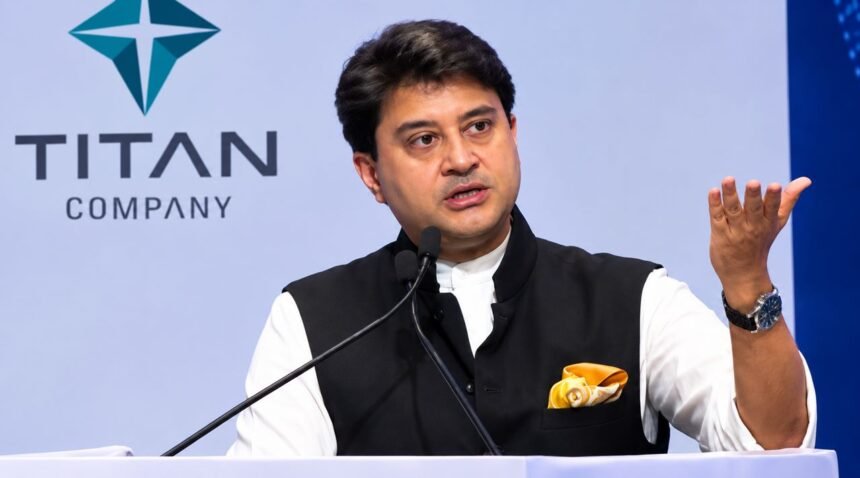
Union Minister of Communications Jyotiraditya Scindia delivered a key address at the Kautilya Economic Conclave 2026. Highlighting the nation’s technological progress, AI Must Democratise Intelligence: Jyotiraditya Scindia Lays Out India’s Digital Future by emphasizing that artificial intelligence must empower every single citizen across the country. Speaking at the event, Scindia noted that Digital India successfully democratised connectivity access. Therefore, artificial intelligence must now democratise intelligence across all socio-economic sectors.
Telecom network expansion drives national digital transformation
Furthermore, the Minister stated that artificial intelligence cannot remain confined to large corporations and big banks. Scindia emphasized that technology must actively empower small merchants and rural artisans across every region. Consequently, the government aims to achieve this goal by converging one billion citizens on high-speed 5G networks.
Additionally, national telecom infrastructure expansion continues to accelerate under key public initiatives. The BharatNet project is connecting 6,500,000 villages with 100 Mbps broadband links. Meanwhile, India has issued 1.35 billion Aadhaar cards while Unified Payments Interface (UPI) handles Rs 3.4 trillion in monthly transactions.
| Digital Infrastructure Component | Scale & Current Progress |
| BharatNet Rural Connectivity | 650,000 villages connected at 100 Mbps |
| Aadhaar Identity Base | 1.35 billion digital identity cards issued |
| UPI Payment Growth | 21,500 crore transactions processed in FY 2025–26 |
| Global Payment Share | ~49% of global real-time digital payment volume |
| 5G Target User Base | Expanding from 500 million to 1 billion by 2030 |
India launches indigenous 4G stack and expands 5G targets
Specifically, India has entered the exclusive telecom equipment manufacturing club after 50 years. The nation successfully deployed its indigenous 4G technology stack across 100,000 telecom towers. Furthermore, authorities will roll out this technology on 5G networks very soon.
Besides infrastructure, the government supports the India AI Mission with an allocation near Rs 10,000 crore. This flagship initiative brings together 38,000 GPUs, 14 cloud partners, and 7,500 data sets. Combining compute capacity with telecom networks creates a new digital trinity of connectivity, compute, and trust.
Protecting citizens against digital fraud remains top priority
However, Scindia cautioned that greater technological intelligence demands greater public responsibility. Fraud operates across digital silos, so regulatory systems must collaborate to build lasting public trust.
Thus, mobile phones now serve as individual bank branches while connectivity functions as a digital highway. India currently processes nearly 49% of all global real-time digital payment volumes. The government targets expanding its 5G customer base from 500 million to one billion by 2030.