

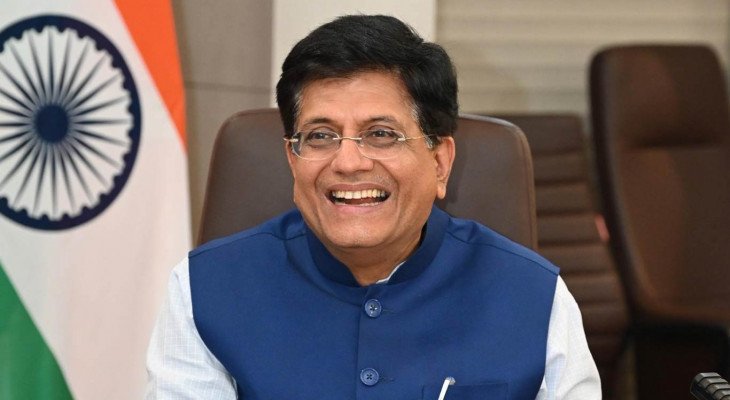
India USD 1 trillion exports target FY27 remains achievable, Commerce and Industry Minister Piyush Goyal said on Tuesday.
He said goods and services exports reached approximately USD 480 billion during April-September 2026-27. This represents 48 per cent of the annual target.
“Our USD 1 trillion export target this year is sacrosanct. We have to achieve it,” Goyal said.
He was speaking at the curtain-raiser event for the Bharat Mobility Global Expo 2027. He also said October’s trade figures showed encouraging trends.
Commerce Secretary Rajesh Agarwal is scheduled to announce the October trade data on November 13.
Goyal urges auto industry to expand global exports
Goyal urged India’s automobile industry to use emerging international market opportunities. He said recently concluded and ongoing free trade agreements could improve market access.
According to the minister, India’s trade agreements will provide preferential access to markets representing nearly 75 per cent of global GDP.
He encouraged manufacturers to expand exports across vehicle categories and mobility segments. Furthermore, he said companies should act quickly to establish their presence in international markets.
“The world is watching you and it’s always the initial period where you have to really achieve and capture markets,” Goyal said.
He added that the government had worked to address industry expectations regarding market access and policy support.
India-EU trade pact offers opportunities for mobility sector
Goyal highlighted the opportunities emerging from the trade agreement with the 27-member European Union. He said the agreement could strengthen India’s position in the global mobility ecosystem.
He referred to Europe’s declining automobile production. The region produced 15.4 million cars in 2007, falling to 14.5 million in 2019.
Production declined further to 11.5 million in 2025, he said.
Goyal said European manufacturers faced challenges from manufacturing costs and regulatory requirements. He explained that access to India’s market could help companies assess consumer demand.
European manufacturers could initially introduce selected models to test the Indian market. Subsequently, companies could consider manufacturing those vehicles in India.
He said local production could serve both Indian consumers and international markets. Economies of scale could also help manufacturers offer vehicles at competitive prices.
The minister encouraged Indian companies to explore collaborations with European manufacturers. He said opportunities could extend across startups, steel producers and rubber manufacturers.
Consequently, the proposed partnerships could expand the wider automotive supply chain. Goyal urged domestic companies to capture these opportunities before competitors did.
Maruti Suzuki’s exports highlight India’s manufacturing potential
Goyal cited Maruti Suzuki’s export operations as an example of India’s changing mobility landscape. He noted that the company now supplies vehicles to Japan and more than 50 other countries.
He also referred to the company’s earlier position on electric mobility. In a lighter remark, he recalled joking that the company was resisting the electric vehicle transition.
However, he said Maruti Suzuki had since expanded its presence in electric mobility.
Goyal said manufacturers should use India’s domestic market alongside international demand. This combination could create larger production volumes and improve cost competitiveness.
“If we supplement our domestic market with global markets, that scale will make us so competitive, that nobody on earth can beat us on pricing,” he said.
He also highlighted the employment potential of the mobility sector. According to Goyal, the industry could increase employment from around 3 crore currently to 10 crore in the coming years.
Bharat Mobility Global Expo 2027 to expand its scope
The third edition of Bharat Mobility Global Expo will take place across Bharat Mandapam and Yashobhoomi. It will cover more than 2.5 lakh square metres of exhibition space.
The event will feature 11 concurrent shows and over 1,750 exhibitors. Organisers expect more than 10 lakh visitors.
The 2027 edition will cover established automotive segments and emerging mobility technologies. These include air mobility, urban mass transit, agri-mobility, batteries and energy solutions.
It will also showcase next-generation transportation systems and advanced mobility technologies.
Speaking at the event, Commerce Secretary Rajesh Agarwal urged manufacturers to prioritise innovation. He said the global mobility industry was undergoing significant transformation.
“We need to be ahead in the innovation curve,” Agarwal said. He also encouraged the industry to support micro, small and medium enterprises.
He said stronger collaboration with MSMEs would help promote sustainable growth across the sector.