

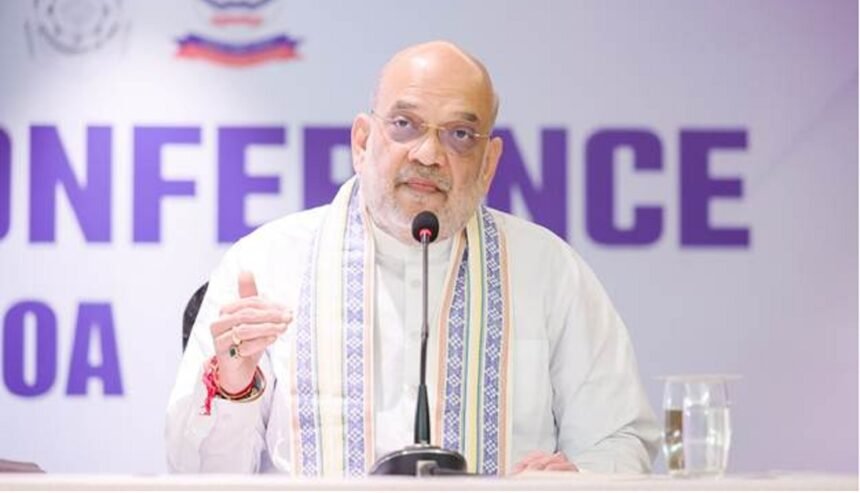
Union Home Minister Amit Shah addressed a comprehensive press conference on national security and narcotics control in Panaji on Wednesday, joined by Goa Chief Minister Pramod Sawant. Reviewing the evolution of India’s internal security landscape since 2014, the Home Minister noted that the central government inherited severe challenges across multiple fronts, including terrorism in Jammu and Kashmir, widespread Naxalism, and insurgency in the Northeast.
According to Shah, robust administrative interventions have fundamentally reversed these trends:
- Jammu & Kashmir: Following the abrogation of Article 370, separatist sentiment has sharply declined, terrorism metrics are moving toward zero, and integration with the mainland has accelerated.
- Naxalism: Describing the decades-old Red Corridor challenge as “almost a thing of the past,” he noted that large numbers of individuals have surrendered and joined the mainstream.
- Northeast Insurgency: Over 11,000 youth have laid down arms following more than 14 peace agreements facilitated by the central government.
- Fugitive Extraditions: Through institutionalized mechanisms like ‘BHARATPOL’—which links over 14 central agencies and state police forces—274 serious criminal and economic fugitives were extradited from 36 countries between 2019 and July 2026, alongside the issuance of 401 Red Corner Notices in the past three years. Additionally, properties worth approximately ₹17,874 crore belonging to fugitives have been attached or confiscated.
A Zero-Tolerance Strategy Against Narco-Terrorism
Pivoting to the core focus of the briefing, Shah emphasized that narcotics networks directly fund terrorism and threaten future generations, making it a pivotal national security priority. Contrasting current efforts with the piecemeal approach before 2014, he highlighted a coordinated, institutional national strategy initiated under the four-tier NCORD framework established in 2019.
Key milestones and comparative metrics highlighted during the briefing include:
- Massive Seizures: Between 2014 and 2026, drug seizures surged to over 1.19 crore kilograms valued at approximately ₹1.89 lakh crore, compared to 26 lakh kilograms valued at ₹40,000 crore between 2004 and 2014. Furthermore, 48.68 lakh kilograms of seized drugs have been destroyed over the past decade.
- Reverse Investigations: Law enforcement has shifted from localized seizures to end-to-end tracing—utilizing the NIDAAN portal, CCTNS data integration, and ‘Bottom-to-Top’ and ‘Top-to-Bottom’ methodologies to dismantle inter-state and international syndicates.
- Financial and Technological Tracking: Dedicated cells focusing on darknet, crypto transactions, and financial audits under PIT-NDPS have been strengthened to choke the financial pipelines of drug kingpins.
- Rehabilitation and Awareness: Through the Nasha Mukt Bharat Abhiyan, over 25 crore citizens have been engaged, while 5.70 lakh individuals have received treatment and rehabilitation support via mechanisms like the ‘1933’ Manas helpline.
Commending local governance, Shah praised the Goa government and police for swiftly implementing new criminal laws and raising the state’s conviction rate to 53.2 percent—marking a nearly 30 percent improvement.
A Strict 2026–2029 Roadmap for a Drug-Free India
Looking toward the future, the Home Minister announced a structured three-year roadmap (July 2026 to July 2029) operating in mission mode. Designed to achieve Prime Minister Narendra Modi’s vision of a drug-free youth anchoring a Viksit Bharat by 2047, the strategy rests on four core pillars:
- Intelligence and Operation-Based Enforcement: Enhancing border surveillance via the BSF, CISF, Indian Coast Guard, Customs, and DRI through risk-based profiling and advanced cargo scanners.
- Precursor and Synthetic Drugs Control: Establishing robust inter-ministerial coordination to regulate chemical precursors.
- Demand and Harm Reduction: Scaling up community awareness, school programs, and rehabilitation infrastructure.
- Capacity Building and Coordination: Strengthening inter-agency synergy through the CBI, Interpol, Enforcement Directorate, and financial intelligence units to track money trails and secure global extraditions.
Reiterating the government’s absolute resolve, Shah concluded, “Just as Naxalism was eliminated from the country, we will eliminate the problem of drugs.”