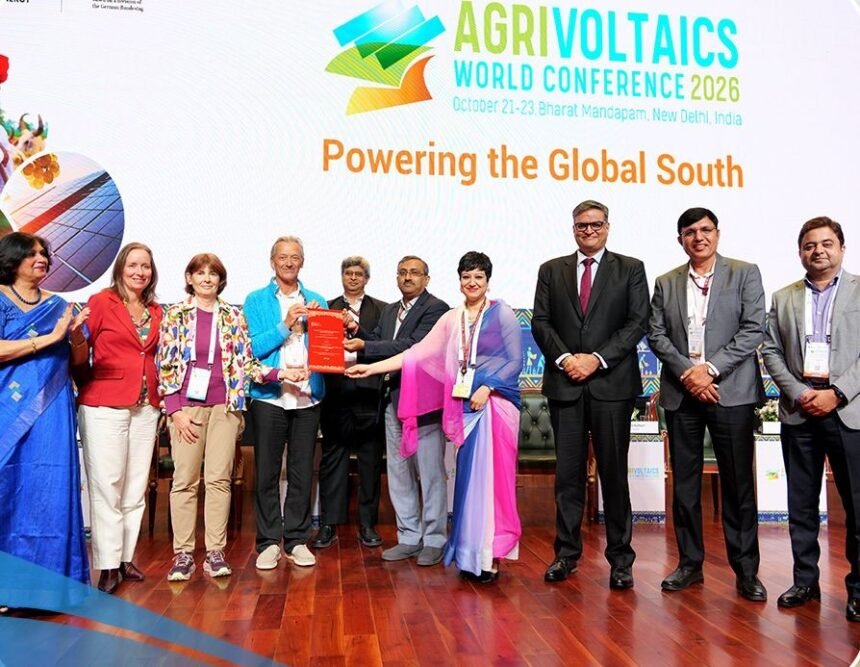
New Delhi, Friday: The 7th AgriVoltaics World Conference 2026 concluded on Friday with a call to move from discussions to practical implementation, as researchers, farmers and industry representatives examined how solar power generation can coexist with agricultural production. France will host the eighth edition in 2027.
Held at Bharat Mandapam, the three-day conference brought together policymakers, scientists, development partners, industry representatives and farmers to explore agrivoltaics as a way to diversify farm incomes, support food security and expand renewable energy deployment.
The discussions focused on the conditions required to make projects viable, including crop selection, agro-climatic suitability, water-use efficiency, farmer participation, innovative financing and technical skills. Participants also highlighted the need to connect scientific research with field experience and ensure that project designs reflect local farming conditions.
Research to guide project design
A session co-convened by the Indian Council of Agricultural Research (ICAR) and the International Water Management Institute (IWMI) examined how agro-climatic zoning could guide agrivoltaic deployment.
Discussions covered shade-tolerant crops, water-use efficiency indices and the microclimatic effects of solar arrays across different agro-climatic zones. The focus was on developing location-specific approaches rather than applying a uniform model across regions with different crops, weather conditions and water requirements.
Such evidence can help identify suitable crop-panel combinations and inform decisions on panel placement, spacing and agricultural practices. This is important to ensure that solar installations support energy generation without undermining farm productivity.
Skills and rural livelihoods in focus
The Skill Council for Green Jobs, in collaboration with the Ministry of Skill Development and Entrepreneurship, facilitated discussions on specialised training for agrivoltaic systems.
The sessions examined skill requirements for installation, operation, maintenance and agricultural management. Integrating these capabilities could create employment opportunities across solar infrastructure, irrigation, crop cultivation and modern farm management.
The conference also highlighted the potential for rural youth to develop technical skills and access employment closer to home as agrivoltaics expands. Building a trained workforce will be important to support projects throughout their operating lives, from installation to maintenance and farm-level management.
Farmers bring field experience to discussions
A dedicated session led by GIZ brought together progressive farmers, Farmer Producer Organisation federations and rural entrepreneurs to share experiences from agrivoltaic installations.
Participants discussed operational lessons, maintenance practices and opportunities to diversify farm revenue. Their experiences reinforced the need to incorporate farmers’ feedback into project design and implementation, rather than relying exclusively on technical assessments.
The discussions also highlighted the importance of economic viability and local suitability. Project models must account for agricultural requirements and farmers’ circumstances if they are to gain wider acceptance and deliver sustained benefits.
Awards recognise research and innovation
Presenting an overview of the conference proceedings, International Solar Alliance Director General Ashish Khanna highlighted opportunities to advance agrivoltaics through research, innovation and international collaboration.
MNRE Additional Secretary Mayank Tewari addressed participants during the closing ceremony, emphasising the need to carry the discussions forward through continued collaboration and practical action.
The ceremony recognised promising enterprise and start-up innovations through the National Agrivoltaics Pitch-Hub Award. Best Paper Awards across six scientific themes honoured research spanning system design, agronomy, monitoring, business models and socio-economic equity.
The awards highlighted efforts to translate scientific knowledge into practical solutions that can support the wider adoption of agrivoltaics.
France to host next edition
The formal handover of hosting responsibility to France marked the next stage of the conference’s international programme. The eighth edition in 2027 is expected to continue exchanges on research, technology and implementation across diverse agricultural and energy settings.
Taina Dyckhoff, Counsellor and Head of the Climate and Environment Division at the Embassy of Germany in India, delivered the vote of thanks at the closing ceremony.
The conference concluded with a focus on translating research into viable projects through farmer participation, appropriate technology, skilled workers and international cooperation. Its discussions underscored that agrivoltaics’ wider adoption will depend on balancing energy generation with agricultural productivity and farmers’ livelihoods.