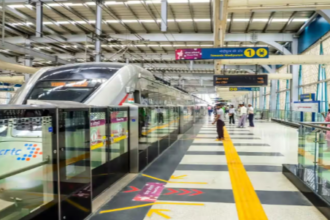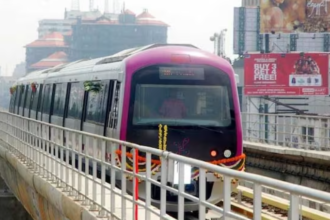


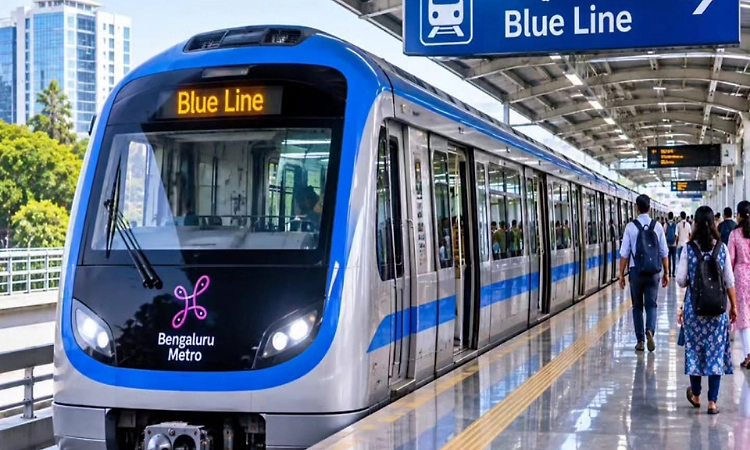
Bengaluru Metro Blue Line trials began from KR Puram on Tuesday, marking progress towards opening the Outer Ring Road corridor by mid-2027.
Karnataka Minister for Greater Bengaluru Development Krishna Byre Gowda said testing had started across the first four stations towards Mahadevapura.
The trials will progressively extend to other stations in the coming weeks. Furthermore, the minister expects automated signalling installation to finish by January 2027.
Gowda inspected construction progress at Doddanekkundi Metro Station. He described the Blue Line as a critical infrastructure project for Bengaluru’s mobility network.
Blue Line trials to expand across Phase 2A stations
The 19-km Phase 2A corridor connects KR Puram with Central Silk Board. It comprises 13 stations along Bengaluru’s Outer Ring Road.
According to Gowda, testing will continue through November. The next phase will extend trials to another four stations in December.
However, automated signalling installation remains pending. The minister expects the work to take another two to three months.
The government aims to complete signalling installation by January. Subsequently, the corridor will undergo mandatory safety certification.
Gowda estimated that testing and certification would require another seven to eight months. Therefore, the government is targeting public operations by mid-2027.
The minister said the Outer Ring Road corridor serves an estimated 11-12 lakh employees. Consequently, Metro connectivity is expected to ease congestion along a major employment and economic corridor.
Entire 58.2-km Blue Line project costs Rs 20,000 crore
The complete Blue Line corridor will span 58.2 km. It will connect Central Silk Board through KR Puram and Hebbal to Kempegowda International Airport.
Officials have estimated the project’s cost at around Rs 20,000 crore. The government is targeting completion of the entire corridor within the next 18 months.
Meanwhile, Gowda directed officials to accelerate construction on Phase 2B. He particularly highlighted the KR Puram-Hebbal stretch, where progress needs improvement.
The minister said the state government was ensuring that funding constraints did not delay ongoing Metro projects.
He added that the state bears loan repayment obligations and provides financial support for the Metro corporation’s operating losses.
Foreign exchange fluctuations have also increased the repayment burden, according to Gowda. He said the dollar had risen from around Rs 70-80 during borrowing to approximately Rs 100.
This increase has added nearly 30 per cent to the loan burden. Additionally, delays in approvals have raised construction material costs and overall project expenditure.
Red Line approval and Sarjapur double-decker proposal
Gowda said the state government had discussed its proposed Red Line Metro expansion with the Centre. However, final approval remains pending.
He said the Chief Minister and he had submitted the proposal to Prime Minister Narendra Modi around 22 months ago.
A recent meeting with central government officials in Delhi discussed the proposal. However, the meeting did not result in a final decision.
The state has also proposed a double-decker corridor from Sarjapur through Ibbalur Junction to St John’s. The proposal aims to integrate Metro and road infrastructure along a rapidly developing stretch.
Metro corporation explores financial sustainability
Gowda said the government was examining ways to strengthen the Metro corporation’s revenue streams. The objective is to reduce its dependence on government grants.
Ticket revenue currently falls short of the corporation’s overall operating expenditure. Including depreciation, its annual loss stands at around Rs 600-700 crore.
However, the corporation estimates an operating surplus of Rs 50-60 crore when depreciation is excluded.
The Blue Line’s launch will also increase operating expenditure. Nevertheless, Gowda said the government wanted to build a financially sustainable Metro system.
He clarified that the government had taken no decision on increasing Metro fares. He also said comparisons with Delhi Metro must consider differences in government support, network length and passenger volumes.