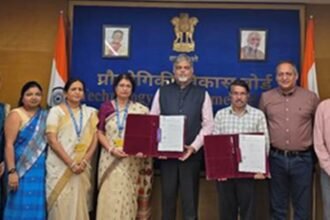
IN-SPACe offers Rs 67 crore to four startups under its Technology Adoption Fund (TAF) to pioneer indigenous space technology. Specifically, the Indian National Space Promotion and Authorisation Centre selected Manastu Space, Inspecity Space Laboratories, VyomIC, and MumbaiSemi for grants totalling Rs 67.15 crore. Furthermore, this latest tranche expands the total number of private companies funded under the TAF framework to seven.
Breakthrough propulsion and in-orbit servicing innovations
Mumbai-based Manastu Space received the highest allocation of Rs 22.08 crore to build an iodine-based Hall Effect Thruster for small satellites. Consequently, this technology eliminates high-pressure xenon tanks and offers a cost-effective alternative for orbital manoeuvring.
Meanwhile, Inspecity Space Laboratories secured Rs 21.18 crore to design a refuellable six-degree-of-freedom propulsion system. Therefore, the green bipropellant engine will enable flexible microsatellite positioning and support future in-space servicing missions.
| Startup & Base Location | TAF Funding Grant | Core Indigenous Space Technology |
| Manastu Space (Mumbai) | Rs 22.08 crore | Iodine-based Hall Effect Thruster for small satellites |
| Inspecity Space Laboratories (Maharashtra) | Rs 21.18 crore | Refuellable 6-DOF green propulsion system |
| VyomIC / AeroDome Tech (Bengaluru) | Rs 12.55 crore | Highly stable and secure space-grade precision clocks |
| MumbaiSemi (Mumbai) | Rs 11.34 crore | Multi-channel NavIC & GPS receiver System-on-Chip |
| Total Second-Round TAF Allocation | Rs 67.15 crore | Advanced Deep-Tech Space Infrastructure |
Indigenous precision timing and navigation microchip technology
Bengaluru-based VyomIC received Rs 12.55 crore to manufacture highly stable, secure atomic timekeeping clocks. Specifically, these clocks cater to Low Earth Orbit positioning systems, deep space exploration, and satellite constellations.
Additionally, MumbaiSemi earned an offer of Rs 11.34 crore to produce an indigenous multi-channel System-on-Chip (SoC). This chip integrates RF and digital components to process NavIC and GPS signals seamlessly. Therefore, as IN-SPACe offers Rs 67 crore to four startups, India significantly curbs its reliance on imported foreign microchips.
Executive quotes for story integration
- “The two spacecraft propulsion technologies are being developed for the first time in India and they have a high commercial potential.” — Dr Pawan Goenka, Chairman, IN-SPACe
- “The development of high stable and precision clock… and indigenous SoC for GNSS including NavIC is going to significantly reduce the dependence of foreign chipsets.” — Dr Pawan Goenka, Chairman, IN-SPACe