

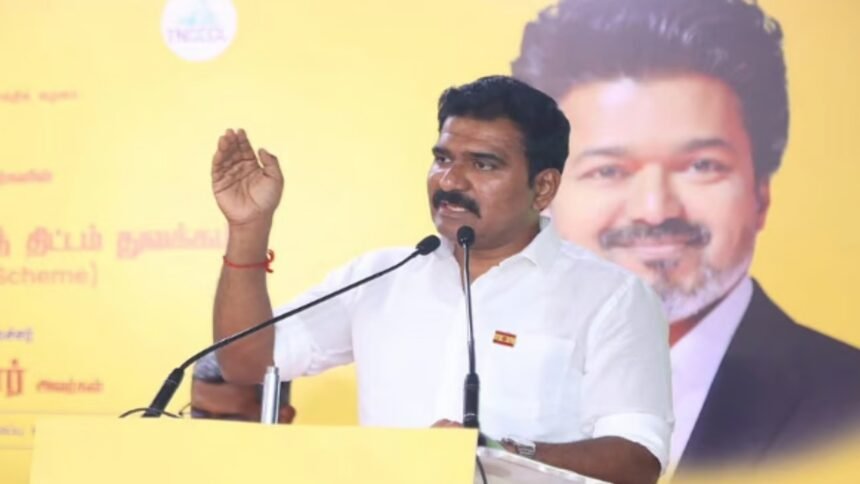
The Tamil Nadu power shortage has pushed the state to procure expensive gas-based electricity, adding up to ₹7 crore to its daily power expenditure as it seeks to avoid load shedding and protect industrial activity. Electricity Minister R Nirmal Kumar said on Wednesday that the state would absorb the additional cost amid a national demand surge. He also announced that Tamil Nadu plans to introduce a comprehensive solar and battery storage policy within a week.
“We have said we will not implement power cuts as it would affect the public,” Kumar told reporters.
The minister said some states, including Maharashtra and Karnataka, had resorted to load shedding, while Tamil Nadu was paying a premium to maintain uninterrupted supply, particularly for industrial and micro, small and medium enterprises (MSMEs).
Gas power prices reach ₹33–35 per unit
Tamil Nadu is procuring 1,000 MW of gas-based power to meet evening peak demand between 6 pm and midnight from October 15 to 31. The electricity is being sourced primarily through central government entity NVVN at ₹33–35 per unit, Kumar said.
The additional procurement is expected to raise daily expenditure by ₹5 crore to ₹7 crore compared with normal purchases.
Kumar said gas-based electricity was currently available at a higher price because thermal power was no longer available in the market. He cited recent purchases from the Assam government at ₹17–18 per unit as an example of the lower cost of thermal power.
He also noted that the baseline production cost for gas power exceeded ₹30 per unit.
Tamil Nadu’s power requirement has reached 21,000 MW, up 5,000 MW from the previous year. The state’s internal generation capacity stands at 5,300 MW, according to the minister.
The efficiency of existing thermal power plants has also improved from 50 per cent last year to more than 73 per cent.
Solar and battery storage policy expected within a week
The state government is preparing a combined solar and battery storage policy to support renewable energy expansion and improve power system stability.
Kumar said approvals for new solar applications had been temporarily held back over the past four months while the government worked on the framework. The state intends to announce the solar policy alongside mandatory battery storage provisions once it receives the necessary approval.
The proposed policy comes as Tamil Nadu faces higher electricity demand and seeks to strengthen its ability to manage peak-hour requirements.
Long-term power tenders planned by month-end
Tamil Nadu plans to move from short-term electricity purchases towards long-term power procurement arrangements. Kumar said long-term power purchase tenders would be issued by the end of October, subject to approval from the Tamil Nadu Electricity Regulatory Commission (TNERC).
He said the state had not initiated long-term contracts since 2013.
The shift is intended to provide greater certainty in power procurement as demand rises and short-term market purchases become more expensive.
Tamil Nadu plans to replace 6,000 ageing transformers
The government will replace 6,000 transformers that are more than 25 years old this year, including 1,000 units in Chennai, Kumar said.
The minister also criticised the previous AIADMK government over the stalled Uppur Thermal Power Project in Ramanathapuram district, where around ₹6,000 crore had been invested.
The supercritical coal-fired project encountered legal and environmental hurdles, including challenges over land acquisition and concerns raised by local farming and fishing communities. On March 18, 2021, the southern bench of the National Green Tribunal kept the project’s environmental clearance in abeyance and directed the project proponent to suspend work.
Kumar said a project report was being prepared to examine the facility’s revival, including coal transportation logistics.
He added that approvals had been granted to increase the planned capacity of Udangudi Stage 2 and Stage 3 projects from 600 MW to 800 MW. Work is also underway to complete North Chennai Stage 3.
The measures form part of the state’s broader effort to address immediate supply pressures while strengthening generation, procurement and electricity infrastructure.