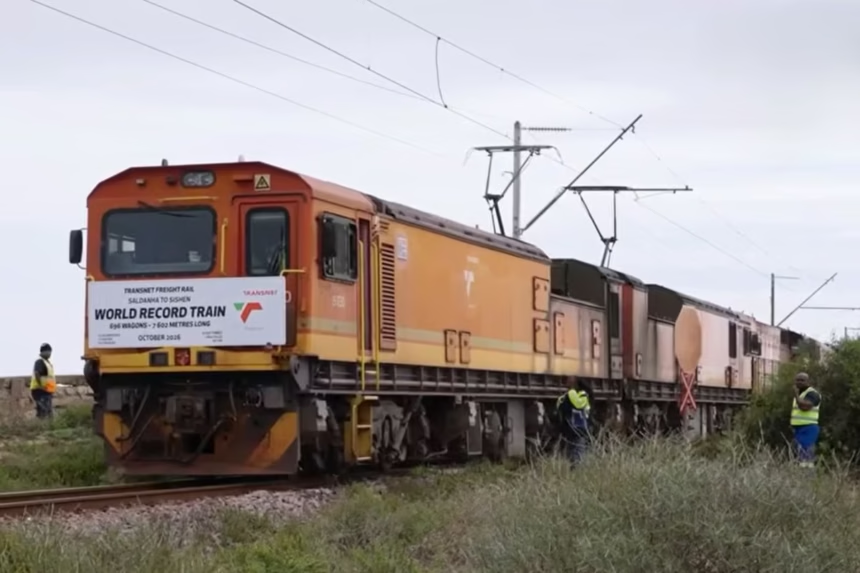
Transnet Freight Rail has operated a 696-wagon train measuring 7.6 km on South Africa’s Sishen-Saldanha iron ore corridor, exceeding the length of the previous world-record freight train.
The formation was approximately 247 metres longer than the previous record and contained 14 additional wagons. However, independent certification of the new record has not yet been confirmed.
The previous Guinness-listed record was set by BHP Iron Ore in Australia in June 2001. That train comprised 682 wagons and measured 7.353 km while transporting iron ore to Port Hedland.
Transnet’s latest operation demonstrates the company’s ability to operate exceptionally long freight formations. However, the company has not confirmed whether trains of this length will become part of regular commercial operations.
Transnet Freight Rail uses distributed locomotive control
The 696-wagon train operated using Class 15E electric and Class 43DE diesel-electric locomotives positioned at different points throughout the formation.
The locomotives were controlled using Radio Distributed Power (RDP), a system that coordinates traction and braking across a long train.
Distributed control helps manage longitudinal forces generated during acceleration and braking. This is particularly important for exceptionally long freight trains, where uneven forces can increase operational risks and mechanical stress.
Transnet has not disclosed the total number of locomotives deployed, the train’s gross weight or whether the wagons were loaded during the operation.
The train also travelled inland from Saldanha towards the mining region. This differed from a conventional iron ore export movement towards the coast.
Sishen-Saldanha corridor resumes operations after maintenance
The train movement followed a scheduled maintenance shutdown on the Sishen-Saldanha corridor from October 6 to 16.
During the shutdown, infrastructure manager TRIM carried out track, signalling and electrical works. The corridor serves as a key route for transporting iron ore from South Africa’s mining region to the export terminal at Saldanha.
The operation demonstrated the movement of a formation considerably longer than the previous record train. However, Transnet has not indicated whether the trial will lead to changes in its regular freight operations.
Impact on South Africa’s rail freight capacity remains unclear
Operating longer trains can potentially increase the volume of freight moved in a single formation. However, the actual benefit depends on factors including wagon payloads, locomotive performance, infrastructure capacity and operating schedules.
Transnet has not disclosed whether the 696-wagon movement will affect the corridor’s annual freight capacity or lead to routine use of similarly long trains.
The absence of published details on loading, gross weight and locomotive numbers also limits comparisons of the operation’s overall freight performance with the previous record.
For now, the movement marks a significant operational demonstration on one of South Africa’s major iron ore rail corridors, while its implications for commercial freight capacity remain unconfirmed.