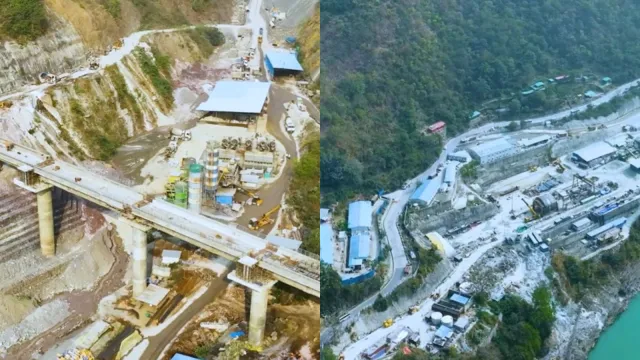
The Rishikesh-Karnaprayag railway project spans 125 km through the Himalayas, with around 83 per cent of its alignment running through tunnels, Railway Minister Ashwini Vaishnaw said on Thursday.
The strategically significant railway link in Uttarakhand includes 16 tunnels, 19 bridges and 12 stations. Approximately 104 km of the alignment involves tunnelling, making it a technically demanding infrastructure project.
In a post on X, Vaishnaw described the line as Uttarakhand’s “lifeline to the future”. He highlighted the engineering challenges posed by the region’s complex geology and the specialised tunnel boring machines (TBMs) developed to address them.
Himalayan geology poses challenges for railway tunnelling
Vaishnaw said the project’s alignment passes through the young fold mountains of the Himalayas, where soft geological formations can cause tunnel cavities to squeeze inward during excavation.
Unlike solid rock, softer strata can exert pressure on excavated tunnels, requiring specialised equipment and engineering solutions.
The minister said extensive investigations were conducted before TBMs were selected for the project. Engineers then modified the machines to address the expected ground conditions.
The modifications included changes to the cutter heads and the shields housing the segmental lining assembly. Engineers also adapted the drive systems to deliver additional torque and thrust.
According to Vaishnaw, these specialised modifications have helped the TBMs operate successfully under the project’s geological conditions.
Rishikesh-Karnaprayag railway project sees progress on key tunnels
Vaishnaw said construction had reached an advanced stage across most sections, with tunnels T-1 and T-5 requiring continued work.
Tunnel T-1, which spans 11 km, presents particularly difficult geological conditions. The minister also cited the presence of human settlements along the stretch.
Micropiles are being used to stabilise the area, he said, adding that work on T-1 and T-5 was progressing.
The 12 stations on the route include Shivpuri, Byasi, Devprayag, Janasu, Maletha, Srinagar, Dhari Devi, Tilani, Gholtir, Gauchar and Karnaprayag.
Railway link expected to improve pilgrimage access
The railway line is expected to improve connectivity to Karnaprayag and Rudraprayag and facilitate pilgrimages to Kedarnath and Badrinath.
Vaishnaw also highlighted the project’s strategic importance, noting that its terminal station at Karnaprayag is around 123 km from the India-China border.
The railway link is expected to strengthen access through Uttarakhand’s mountainous terrain, where road journeys can be challenging.
India expands domestic tunnel boring machine manufacturing
In a separate post, Vaishnaw highlighted India’s growing domestic capacity to design, manufacture and maintain TBMs.
He said 8-metre-diameter TBMs are now manufactured in India, while domestic production of 15-metre machines has also begun. A TBM manufacturing plant is located in Tamil Nadu.
The minister added that India aims to manufacture machines exceeding 16 metres in diameter in the near future.
He said domestic manufacturing would reduce reliance on imported equipment as India expands infrastructure construction across railways, highways and power projects.
The development forms part of the government’s Aatmanirbhar Bharat initiative, with domestic capabilities spanning TBM design, manufacturing and maintenance.