


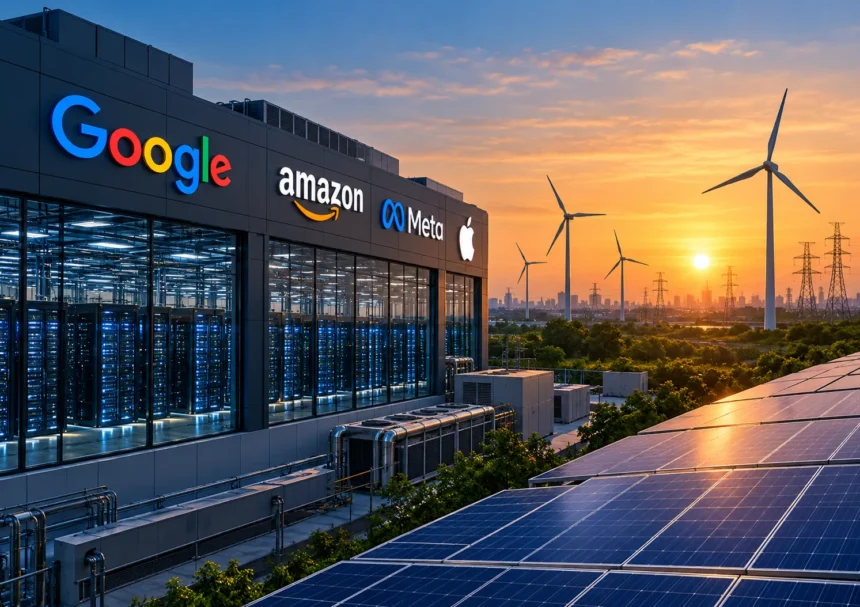
India data centre renewable energy demand is poised to rise sharply as artificial intelligence infrastructure expands, with growing investment in computing facilities creating new opportunities for clean power suppliers.
CleanMax Enviro Energy Solutions Managing Director and Founder Kuldeep Jain said the renewable power requirements of AI infrastructure remain significantly underestimated. Even if India adds 5 gigawatts (GW) of data centre capacity, the country could need 30-40 GW of renewable power, he said in an interview with Bloomberg in Mumbai.
The growth comes as India attracts data centre developers through incentives, including power tariff subsidies, tax breaks and faster land clearances. BloombergNEF ranks India as the leading data centre development market in Asia-Pacific outside China.
AI data centre expansion to drive renewable investments
Meeting the power requirements of new data centres will require substantial investment in renewable generation and energy storage, Jain said.
CleanMax is adding around 1.5 GW of solar and wind capacity annually, with yearly capital expenditure of up to ₹9,000 crore, according to Jain.
He estimated that powering a 1 GW AI data centre with a 75 per cent renewable energy share would require around 3 GW of solar capacity, 3 GW of wind capacity and 3 gigawatt-hours (GWh) of energy storage.
The renewable infrastructure alone would require capital expenditure of approximately ₹40,000 crore, he said.
These requirements highlight the scale of investment needed to match the growth of energy-intensive AI computing with cleaner electricity sources.
CleanMax signs renewable power deals with AI hyperscalers
The Brookfield Asset Management-backed company has signed renewable power supply agreements with several major technology companies, including Meta Platforms, Google, Apple and Amazon.
According to Jain, CleanMax will supply 1.8 GW under these agreements, accounting for roughly one-third of India’s contracts with AI hyperscalers over the past three years.
He said hyperscalers increasingly prefer flexible power arrangements. Under these contracts, companies can purchase the environmental attributes of renewable projects to offset emissions without necessarily taking physical delivery of electricity at their data centres.
Alternatively, renewable suppliers can sell electricity on exchanges and settle the difference between the agreed tariff and the market price, Jain explained.
He said this flexibility allows hyperscalers to choose how they procure renewable power while providing suppliers with the same contracted realisation.
India data centre capacity set for further growth
India’s appeal as a data centre destination has also been strengthened by concerns over public opposition to resource-intensive facilities in the United States and geopolitical risks in the Middle East, Jain said.
He cited the threat of wider regional conflict as another factor influencing companies’ location decisions. In July, two Amazon data centres were damaged in an Iranian strike in Bahrain, according to the report.
Data centre development in India is already progressing. BloombergNEF data cited in the report shows that facilities with 1.3 GW of IT capacity are under construction. Projects with another 3.2 GW of capacity have secured land, power and permits.
Wood Mackenzie expects India’s total data centre capacity to reach 12 GW by 2030. AI-specific capacity could increase nearly 24-fold to 6.5 GW over the same period.
The projected expansion is likely to increase demand for renewable electricity, storage systems and flexible power procurement arrangements as operators seek to meet the energy requirements of AI infrastructure.