New Delhi: States are exploring agrivoltaics to expand renewable energy generation without displacing agricultural activity, with land-use safeguards, farmer participation, financing and power evacuation emerging as key priorities.
States are looking to integrate solar power generation with agricultural activity, with Odisha preparing a dedicated policy targeting 1 GW of agrivoltaic capacity by 2030, while Uttar Pradesh, Madhya Pradesh and Bihar highlighted implementation challenges and ongoing renewable energy initiatives.
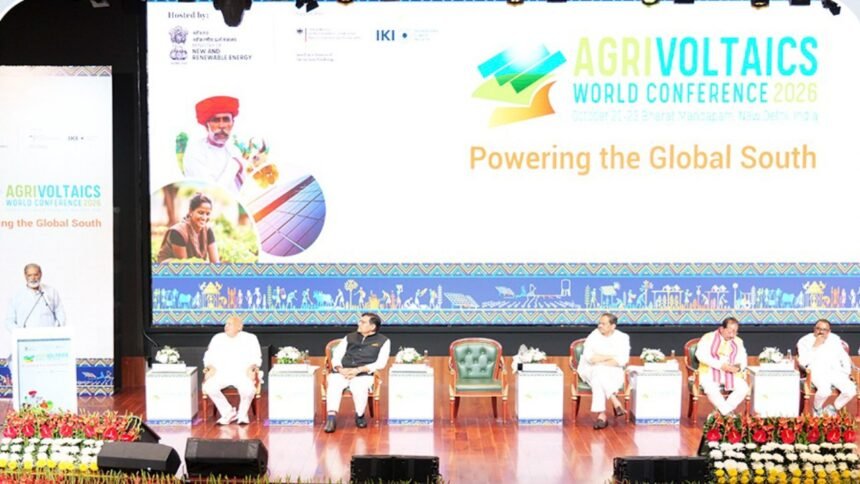
Speaking on Day 2 of the 7th AgriVoltaics World Conference 2026 at Bharat Mandapam, New Delhi, on Thursday, ministers from the states discussed ways to expand solar power generation while allowing farmers to continue cultivating their land.
Odisha Deputy Chief Minister Kanak Vardhan Singh Deo said the state was finalising its AgriVoltaic Policy 2026, which aims to make the state the first in India with a dedicated policy for the sector.
The proposed framework targets 1 GW of capacity by 2030 and stipulates that at least 90% of each project site must remain cultivable. It also envisages farmer consent, continued crop insurance and options for farmers to own solar installations or lease land to developers.
“In Odisha, the farmer comes first. The solar panels come second,” Singh Deo said.
The proposed policy also envisages 25-year power purchase agreements with GRIDCO, alongside power offtake arrangements and grid connectivity. Singh Deo said Odisha had 40.7 lakh hectares of farmland suitable for crops that could be integrated with solar installations.
A 1 MW AgriPV project in Kurabi village, Koraput, has received the required approval and is expected to be commissioned soon, he added.
UP flags land fragmentation, financing challenges
Uttar Pradesh Energy Minister Arvind Kumar Sharma said agrivoltaics could help increase renewable energy generation without dedicating additional farmland exclusively to conventional ground-mounted solar parks.
“The same field can produce both crops and electricity,” Sharma said, highlighting the potential to diversify farmers’ incomes while retaining land for cultivation.
However, fragmented landholdings remain a challenge. Sharma said around 80% of agricultural holdings in Uttar Pradesh were below one hectare, requiring project designs and commercial models suited to small and marginal farmers.
“How to do it from the technology point of view, the financing point of view and how to do it fast from the administration point of view” are the key questions, he said.
He called for financing mechanisms that minimise farmers’ upfront investment burden, citing bank participation as an important factor behind rooftop solar adoption under the PM Surya Ghar scheme.
Sharma also flagged grid connectivity and power evacuation as critical requirements, particularly for projects in rural and remote areas. Uttar Pradesh plans to undertake a pilot project before developing a dedicated agrivoltaics policy, he said.
State Agriculture Education and Research Minister Surya Pratap Shahi stressed the need for farmer training and land-tenure safeguards. He said farmers should retain ownership of their land and called for agricultural universities, Krishi Vigyan Kendras and technical institutions to help develop suitable cultivation practices.
Bihar advances feeder solarisation, MP explores integration
Bihar Energy Minister Shailesh Kumar Mandal highlighted efforts to solarise agricultural electricity infrastructure, saying around 2,700 agricultural feeders had recently been separated. The state government had approved financial support of approximately ₹2,700 crore for their solarisation, he said.
Bihar Agriculture Minister Vijay Kumar Sinha said research, field demonstrations and farmer awareness would be important to establish viable agrivoltaic models, particularly for small and marginal farmers.
Madhya Pradesh New and Renewable Energy Minister Rakesh Shukla highlighted the state’s 277 MW floating solar project at Omkareshwar and said some projects were exploring cultivation beneath solar panels.
The state is also pursuing battery energy storage expansion and plans to solarise government buildings through the renewable energy service company (RESCO) model, he said.
Across the states, the discussions highlighted the need to combine renewable energy expansion with agricultural productivity. Wider adoption of agrivoltaics will depend on crop-compatible panel designs, reliable grid infrastructure, affordable financing and safeguards that ensure farmers continue to benefit from their land.