

Set for completion by 2030, a major Rs 10,021-crore railway infrastructure push will add 540 km of multi-tracking lines across 17 districts in Tamil Nadu, Andhra Pradesh, Karnataka, and Telangana. Discover how this project directly impacts daily commuters, boosts local tourism, and cuts down carbon emissions.
Commuters, local businesses, and travelers across Tamil Nadu, Andhra Pradesh, Karnataka, and Telangana are set to experience major improvements in regional mobility following the Union Cabinet’s approval of five major railway multi-tracking projects worth Rs 10,021 crore.
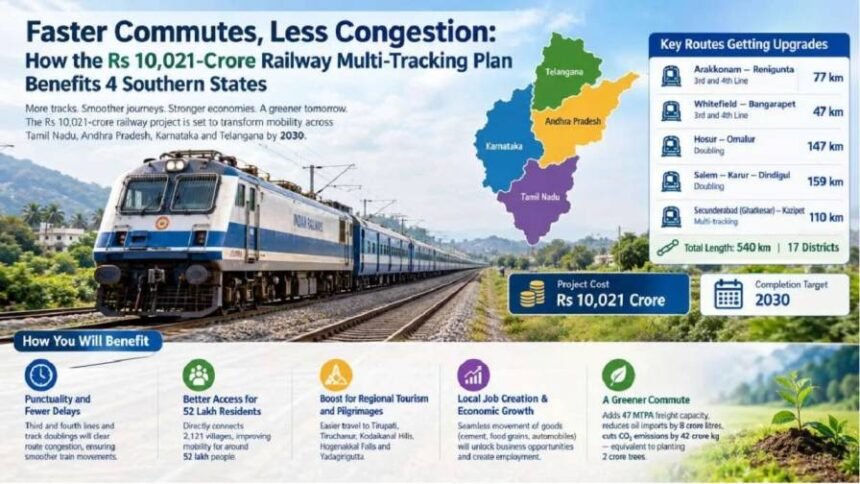
Targeting completion by 2029–30, the initiative addresses chronic bottleneck issues on high-density routes by expanding the existing rail network by roughly 540 kilometers across 17 districts.
Key Routes Getting Upgrades:
• Arakkonam – Renigunta: 3rd and 4th Line (77 km)
• Whitefield – Bangarapet: 3rd and 4th Line (47 km)
• Hosur – Omalur: Doubling (147 km)
• Salem – Karur – Dindigul: Doubling (159 km)
• Secunderabad (Ghatkesar) – Kazipet: Multi-tracking (110 km)
How You Will Benefit
• Punctuality and Fewer Delays: By alleviating route congestion, the third and fourth lines and track doublings will clear the path for smoother train movements, minimizing frustrating delays for daily passenger services.
• Better Access for 52 Lakh Residents: The expansion directly connects approximately 2,121 villages, vastly improving mobility options for roughly 52 lakh people living in these rural and semi-urban corridors.
• Boost for Regional Tourism and Pilgrimages: Travel to major cultural and religious landmarks—including Tirupati, Tiruchanur, Kodaikanal Hills, Hogenakkal Falls, and Yadagirigutta—will become significantly smoother with increased train frequency and reliability.
• Local Job Creation & Economic Growth: Aligned with the PM-Gati Shakti National Master Plan, the seamless movement of goods and raw materials (such as cement, food grains, and automobiles) is expected to unlock local commercial opportunities, generating fresh employment and self-employment avenues.
• A Greener Commute: Beyond passenger convenience, the massive freight capacity expansion (adding 47 MTPA) shifts heavy transport to an eco-friendly rail network. This is projected to cut down oil imports by roughly 8 crore litres and reduce CO2 emissions by 42 crore kg—an environmental saving equivalent to planting 2 crore trees.