



The decision by the Reserve Bank of India (RBI) to raise the repo rate by 25 basis points to 5.50% has rekindled interest in borrowing rates and how they affect home loan borrowers. Home loan interest rates frequently mirror changes in the repo rate since it is a crucial benchmark that affects lending rates throughout the banking system, especially for borrowers whose loans are connected to external benchmarks.
Current customers with floating-rate mortgages may see varying immediate consequences depending on how the lending institution broadcasts the rate rise. Banks may decide to extend loan terms, raise EMIs, or do both. Even while the rise might seem insignificant at first, it can have an impact on the total cost of borrowing over the course of a loan. As a result, borrowers can examine their repayment schedules and evaluate how they will affect their household budget. Prospective homebuyers are also likely to give careful thought to how rising loan rates would impact affordability.
An increase in borrowing costs may somewhat change the amount of a loan that a person is eligible for because loan eligibility is dependent on repayment capacity. However, a variety of factors, such as income growth, job stability, property pricing, infrastructure development, and long-term investment goals, usually have an impact on housing purchase decisions.
What Expert Says
Anurag Mathur, Chief Executive Officer, Savills India said, “The RBI’s decision to raise the repo rate by 25 bps to 5.50% and shift its stance to calibrated tightening is mostly along the expected lines, given heightened global uncertainty, crude price shocks and other economic concerns such as food prices. While higher borrowing costs may pose some near-term challenges, India’s resilient domestic demand, strong economic fundamentals and sustained investment activity should continue to support business confidence. For real estate, higher financing costs could further impact near-term residential demand, particularly in the affordable and mid-income segments.”
Experts noted that the demand for commercial real estate appears largely on track for now, but given the outlook, supply dynamics may need to be calibrated. The sector’s medium-term outlook remains positive though, as the MPC estimated GDP growth to remain healthy and higher than its previous projections. Greater capital discipline will be important all around including real estate, in the current monetary environment, which may tighten further in the near term.
Yashank Wason, Managing Director, Royal Green Realty said, “The real estate industry is expected to be somewhat impacted by the RBI’s 25 basis point increase in repo rates, which raised the policy rate to 5.50%. For homebuyers with floating-rate loans, rising borrowing costs might slightly raise EMIs, but for those with steady incomes and lengthy investment horizons, the effect should be tolerable. Depending on the current lending rate, a 25 basis point rise on a ₹50 lakh, 20-year home loan could result in a slight increase in EMI.”
Assuming a baseline starting interest rate (e.g., around 8.5% to 9.0%), a 25 basis point hike typically increases the monthly EMI by roughly ₹800 to ₹1,100 per ₹50 lakh borrowed over a 20-year tenure, depending on the exact prevailing interest rate, experts said.
Mr. Rahul Singla, Director, MAPSKO Group said of ensuring economic stability and keeping inflation under control. Although it may slightly increase the cost of borrowing, the real estate sector remains supported by strong underlying demand and positive long-term growth drivers. Continued infrastructure investments, urban expansion, and rising aspirations among homebuyers are expected to sustain market activity. We believe the sector’s fundamentals remain intact, and demand for well-planned residential developments will continue to remain resilient in the months ahead.”
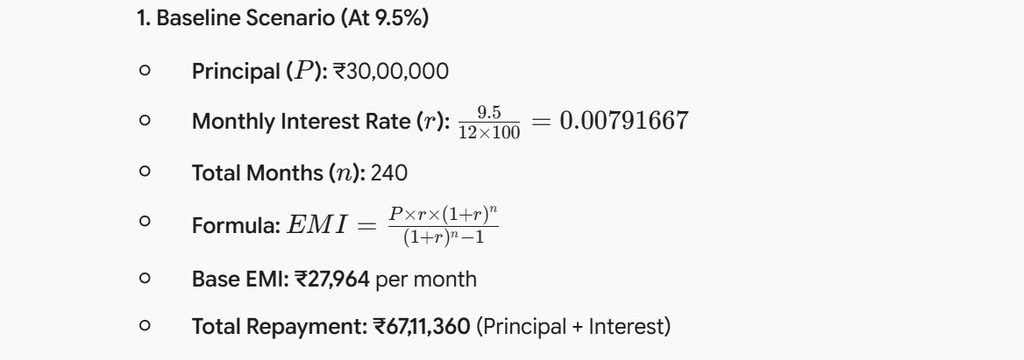
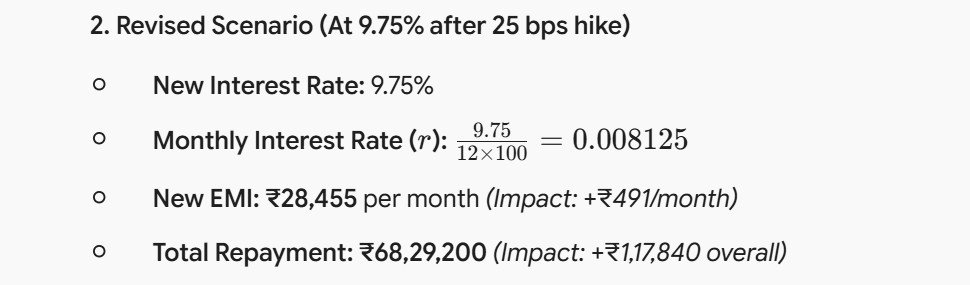
For a ₹30 lakh home loan at an initial interest rate of 9.5% for 20 years (240 months), here is the detailed calculation of how a 25 basis point (0.25% or 0.25 percentage point) repo rate hike impacts your monthly EMI and overall outgo.
Summary
- Monthly EMI Increase: ₹553 per month (from ₹27,964 to ₹28,455)
- Total Interest Cost Increase: ₹1,17,840 over the full 20-year tenure (assuming the loan term is kept constant and banks pass on the rate hike fully by increasing your EMI).
A 25-basis-point rate hike is anticipated to have a gradual rather than an instant effect on the market as a whole. Strong end-user demand, increasing urbanization, and enhanced connectivity across important markets have all contributed to the residential real estate industry’s recent resiliency. Even while financing costs are still a major factor for buyers, consumer confidence and economic fundamentals will probably continue to influence market activity.
Borrowers and industry participants will keep an eye on changes in monetary policy and how they affect housing demand, affordability, and financing patterns in the real estate sector as interest rates change.