
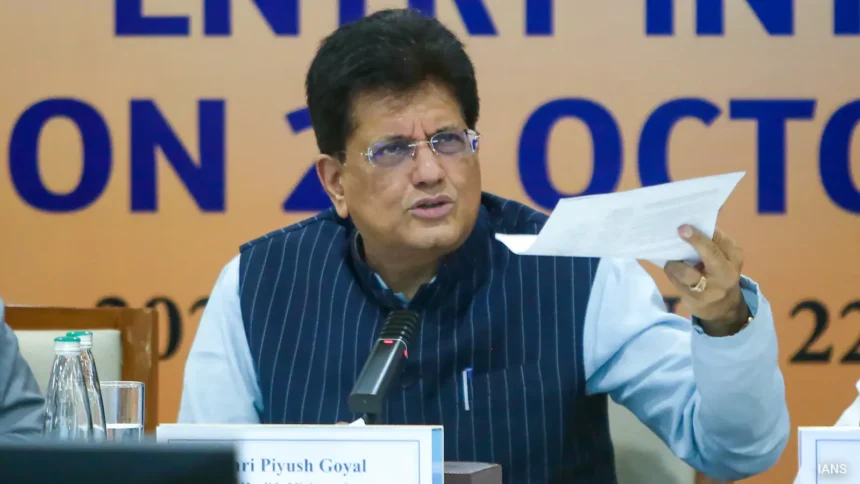
Union commerce and industry minister Piyush Goyal criticised developed countries over their historical carbon emissions and alleged failure to fulfil climate finance commitments under the 2015 Paris Agreement.
Speaking at a roundtable during the Berlin Global Dialogue, Goyal argued that Western countries bore significant responsibility for environmental damage. He contrasted their emissions with India’s contribution, despite the country accounting for 17 per cent of the global population.
“I represent 17% of the world’s population, but my contribution to global carbon emissions is less than 3%,” Goyal said, according to the remarks reported by Hindustan Times.
He also said Europe’s per capita carbon emissions and environmental impact were seven to eight times higher than India’s. Goyal argued that developed countries should bear greater responsibility for addressing climate change.
Piyush Goyal questions $100 billion climate finance pledge
Goyal questioned the delivery of the annual $100 billion climate finance commitment associated with the Paris Agreement.
He said developed countries had agreed to provide financial and technological assistance to developing nations, including vulnerable countries and island states, to help them address climate change.
“At the Paris climate conference in 2015, when the whole world came together, it was Prime Minister Modi who brought the Global South together and encouraged countries to commit to addressing climate change at COP21,” Goyal said.
He added that developed countries had committed to providing $100 billion annually to support developing nations.
“Eleven years later, we haven’t seen a nickel or a dime of that. It’s all promises,” Goyal said, questioning the implementation of the commitment.
He also raised concerns over the European Union’s Carbon Border Adjustment Mechanism (CBAM), which applies a carbon-related cost to certain imports. His remarks linked climate finance obligations with the broader debate over how climate policies affect developing economies.
India’s emissions and renewable energy transition
Goyal’s comments come amid renewed attention to global emissions trends and the distribution of responsibility for climate action.
According to the United Nations Environment Programme’s Emissions Gap Report, released on Wednesday, India recorded a decline in greenhouse gas emissions in 2025 compared with the previous year. The report attributed the decline partly to weather-related factors and partly to structural changes, including the shift towards renewable energy.
India remains the world’s third-largest greenhouse gas emitter in absolute terms. However, its per capita emissions remain below half the global average, according to the report.
The report also noted that total emissions increased in China and the United States, the world’s two largest emitters, during the same period.
Goyal’s remarks highlighted the longstanding debate over climate equity, historical emissions and the responsibility of developed countries to support developing economies. The issue remains relevant as countries assess climate targets, financing arrangements and the economic implications of emissions-related trade measures.