

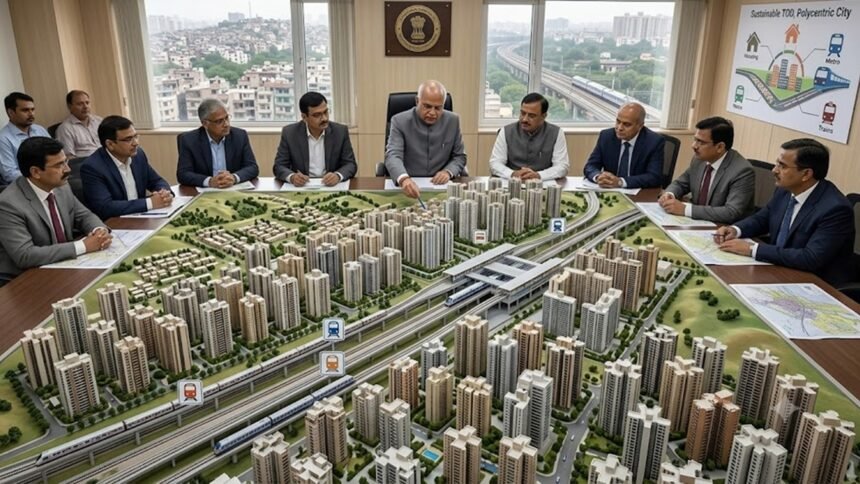
Delhi accelerates TOD policy implementation to address rising housing demands through high-density urban planning. Specifically, Lieutenant Governor Taranjit Singh Sandhu reviewed project progress with senior Delhi Development Authority (DDA) officials on Wednesday. Furthermore, the administration aims to build approximately 17 lakh residential units over the next 10 years along major public transport corridors.
Expanding high-density housing across 207 square kilometres
The comprehensive urban plan covers a total area of about 207 square kilometres around mass transit networks. Consequently, developments will be permitted up to 500 metres on either side of metro corridors, Regional Rapid Transit System routes, and railway stations.
Additionally, the strategy incorporates high-rise residential buildings within a 250-metre zone along both sides of Urban Extension Road-II under Master Plan provisions. Meanwhile, officials emphasized prioritizing affordable housing to accommodate the city’s rapidly growing population.
| TOD Policy & Development Parameter | Urban Planning & Infrastructure Metrics |
| Projected Housing Units | ~17 lakh residential units planned over the next 10 years |
| Target Development Area | Approximately 207 square kilometres around transit corridors |
| Corridor Buffer Zones | 500-metre radius along metros, RRTS, and railway stations |
| Urban Extension Road-II Zone | 250-metre residential zone on both sides under Master Plan |
| Executing Agency | Delhi Development Authority (DDA) under LG oversight |
Enforcing strict timelines and inter-agency coordination
During the high-level review, Lieutenant Governor Sandhu directed officials to complete all designated projects within strict prescribed timelines. Specifically, authorities must maintain rigorous monitoring across every stage of construction to prevent delays.
Furthermore, successful execution requires seamless coordination between the DDA, transport authorities, and developer companies that submitted applications in July. Therefore, as Delhi accelerates TOD policy frameworks, integrated infrastructure will significantly improve urban mobility and living standards citywide.