


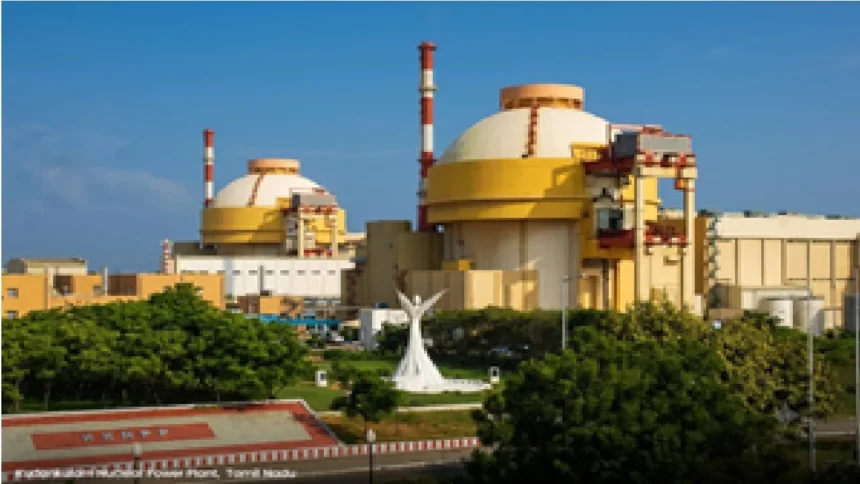
Nuclear safety standards in India: As India moves forward with expanding its clean energy infrastructure, nuclear power plays a key role in the nation’s long-term energy strategy. With ambitious expansion goals and strict regulatory standards, India is building a clean energy framework supported by continuous monitoring, robust physical safeguards, and strict radiation control measures.
Expanding India’s Nuclear Footprint for Viksit Bharat
India operates 24 nuclear power reactors across seven sites, providing a total installed capacity of 8.78 GW. To meet growing electricity demand while reducing carbon emissions, nine additional reactors are under construction, with preparations underway for 10 more units.
These initiatives line up with the Nuclear Energy Mission for Viksit Bharat, which targets 100 GW of nuclear power capacity by 2047.
INDIA'S NUCLEAR LANDSCAPE
+------------------------+------------------------+-----------------
Active Infrastructure | Pipeline Development| Long-Term Target (2047)
+------------------------+------------------------+----------------24 Operating Reactors | 9 Under Construction|100 GW Total Capacity
7 Key Sites | 10 Planned Units | Viksit Bharat Framework
8.78GW Current Output | ₹20,000Cr SMR Budget|SHANTI Act, 2025 Enacted
+------------------------+------------------------+----------------
Policy and financial backing continue to support this expansion:
- Small Modular Reactors (SMRs): The Union Budget allocated ₹20,000 crore to develop indigenous SMR technologies.
- Legislative Framework: The SHANTI Act, 2025, establishes updated regulatory guidelines to support safe and secure nuclear expansion.
- Global Partnerships: India works alongside the International Atomic Energy Agency (IAEA) to align its operations with international nuclear safety, security, and safeguards standards.
Clean Energy Metrics: Nuclear vs. Other Sources
Per unit of installed capacity, nuclear energy is India’s most carbon-efficient clean energy source. During FY 2025–26, one gigawatt of operational nuclear capacity avoided approximately 5.4 million tonnes of $\text{CO}_2$ equivalent emissions.
Compared to other generation methods, nuclear energy avoids significantly more emissions per gigawatt:
- Nuclear Power: 5.4 million tonnes of $\text{CO}_2$ equivalent avoided
- Hydropower: 2.7 million tonnes of $\text{CO}_2$ equivalent avoided
- Wind Power: 1.6 million tonnes of $\text{CO}_2$ equivalent avoided
- Solar Power: 0.9 million tonnes of $\text{CO}_2$ equivalent avoided
Since 1969, India’s nuclear power programme has prevented a cumulative total of 851 million tonnes of $\text{CO}_2$ equivalent emissions—an environmental impact equivalent to the annual carbon absorption of over 38 billion mature trees.
Multi-Layered Safety Infrastructure
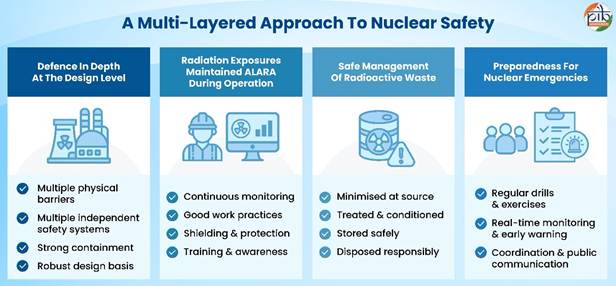
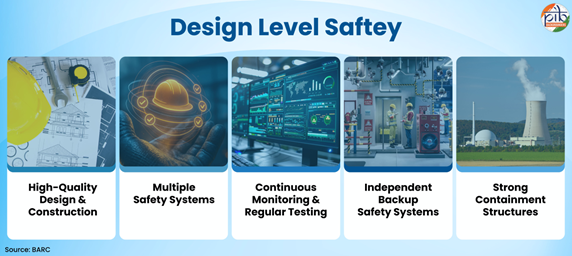
Preventing the accidental release of radiation or radioactive materials into the environment is the central baseline of nuclear plant design. India uses a multi-layered approach to maintain plant safety across design, construction, and daily operations.
1. Defence in Depth Architecture
Indian nuclear facilities incorporate the globally recognized Defence in Depth engineering philosophy, using redundant protection layers to mitigate equipment failures or operational errors. Key physical barriers include:
- Ceramic fuel pellets
- Sealed zirconium alloy fuel rods
- High-strength pressure vessels and pressure tubes
- Reinforced concrete containment structures
Plants are built with independent backup systems to ensure emergency reactor shutdowns, continuous core cooling, and uninterrupted power supply. Structural designs are engineered to withstand natural events, including earthquakes, floods, cyclones, and tsunamis.
2. Operational Radiation Controls & Regulatory Monitoring
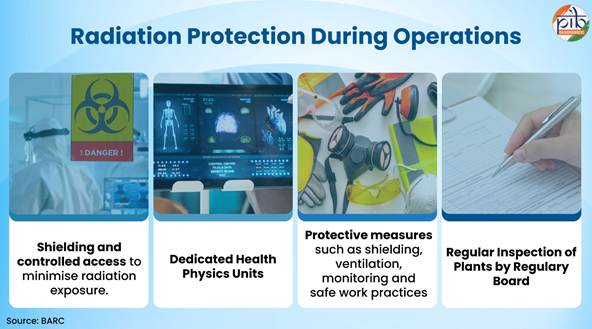
Operational radiation levels are managed using the ALARA (As Low as Reasonably Achievable) principle to protect facility staff and nearby populations.
The Atomic Energy Regulatory Board (AERB) enforces strict exposure limits:
- Radiation limits for public India: 1 millisievert (mSv) per year, ensuring surrounding communities remain safe during normal operations.
- Occupational Limit: An average of 20 mSv per year over five-year cycles, with a maximum limit of 30 mSv in any single year.
Each plant features an on-site Health Physics Unit that tracks ambient radiation levels, monitors worker exposure, checks plant systems, and audits environmental discharges. The AERB conducts routine regulatory inspections to maintain compliance across all facilities.
Common Misconceptions vs. Operational Facts
| Myth | Fact |
| Living near a nuclear power plant is harmful to health. | Radiation near operating plants remains well within safe prescribed limits, posing no health risks to local communities. |
| Radioactive waste cannot be managed safely and contaminates the environment. | Waste is managed through multiple physical barriers, ongoing monitoring, and regulatory oversight. |
| Any amount of radiation is harmful. | Low-level radiation occurs naturally from the sun, soil, air, and food as part of everyday life. |
| India’s nuclear power plants are unsafe. | India maintains a consistent safety record supported by multi-layered barriers and fail-safe control systems. |
| Transporting nuclear material on public roads or railways is extremely risky. | Materials move in tested, heavy-duty containers built to strict national and international safety codes. |
| Nuclear power harms the environment just like coal or oil. | Nuclear generation releases zero direct carbon emissions during operation, replacing fossil fuels without air pollution. |
| Touching plutonium or nuclear material is instantly fatal. | Controlled handling protocols, heavy containment, and protective equipment shield workers from direct exposure. |
| Renewable energy should completely replace nuclear power. | Nuclear and renewables work together; nuclear provides continuous 24/7 baseload power using significantly less land. |